Face Oil for Gua Sha Explained, Step by Step
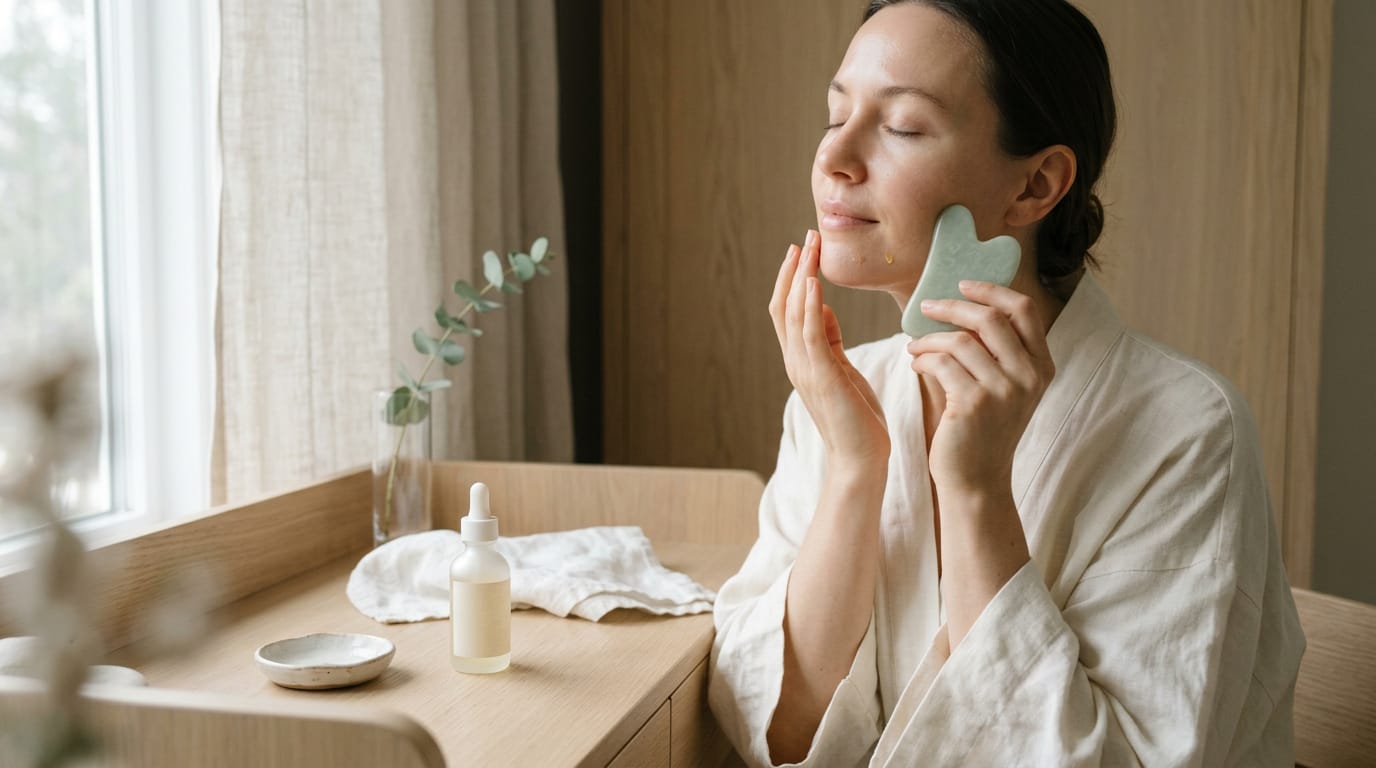
Face oil for gua sha helps the tool glide without scratchy drag. Find an oil for your skin type and learn how to use it safely with the right tool.

Think about wiping a dry window with a squeegee. It squeaks, it drags, and it streaks. Add a little water and the same blade suddenly glides. That’s the job a face oil does for gua sha, the practice of gently stroking a smooth tool across your skin.
In short, oil lets the tool slide so your strokes feel smooth instead of scratchy. In this post, we’ll cover why oil matters, which options suit your skin type, and how to use one safely with the right tool.
What Face Oil for Gua Sha Does
Before you choose an oil, know what the tool does and what people claim it does.
Gua sha’s origins and how it’s done
Gua sha translates to “scraping.” According to a San Jose Acupuncture Center article, practitioners of Traditional Chinese Medicine have used it for centuries to promote healing, circulation, and balance.
Despite the name, the technique is less about pressure and more about glide. You use a flat, smooth-edged tool in slow, gentle strokes over oiled skin. Practitioners say this releases tension in the fascia, the connective tissue around your muscles.
Benefits people claim for skin and body
- Circulation and lymphatic drainage. Cleveland Clinic describes the strokes as a way to try to improve circulation, and many users also link them to lymphatic drainage.
- De-puffing and sculpting. Consider a bride who uses upward strokes over her cheeks and jaw with a light oil, hoping for a less puffy look in the photos.
- Muscle tension and pain relief. Some people use it on tight, sore muscles.
- Firmer skin, fewer fine lines. Many hope regular use makes skin look firmer and fine lines less noticeable.
- Neck, body, and scalp. Some people extend the strokes there too.
What research says about gua sha
A pilot study in healthy subjects found a fourfold increase in microcirculation (blood flow through the skin’s smallest vessels) in the first 7.5 minutes after treatment, and a significant rise held through the full 25-minute study. Minutes, not months.
Other research has looked at back pain. A systematic review and meta-analysis of randomized controlled trials notes that gua sha is widely used in East Asia for perimenopausal symptoms.
Cleveland Clinic says there’s not enough high-quality research to definitively declare its benefits. Promising, but not proven.
Why Skin Needs Oil During Gua Sha
Gua sha depends on smooth, repeated strokes, and a little slip makes them possible. Here’s what face oil adds, and when a serum can step in.
How oil keeps the tool gliding smoothly
A thin layer of oil lets the tool glide without tugging at your skin. Picture a bride doing a quick session the night before her wedding. With oil, the tool moves easily, and her skin still looks like her skin in the morning.
Oil also helps prevent the irritation and redness that friction can cause. Skip it, and every stroke catches, which turns the ritual into a chore.
What oil does for your skin
Oil helps skin hold on to moisture. It’s less about adding water and more about keeping it there. Many face oils also bring vitamins and antioxidants that help protect skin, so each session nourishes as well as glides.
Oil can also help other ingredients absorb better. Pair it with a hyaluronic acid serum (a hydrating ingredient that draws water into skin): apply the serum first, then seal it in with a few drops of oil. Those benefits only last if the oil is fresh.
Over time, oils can turn rancid and smell sharp or stale, so store yours away from heat and sunlight and toss it if it smells off.
Serums you can use instead of oil
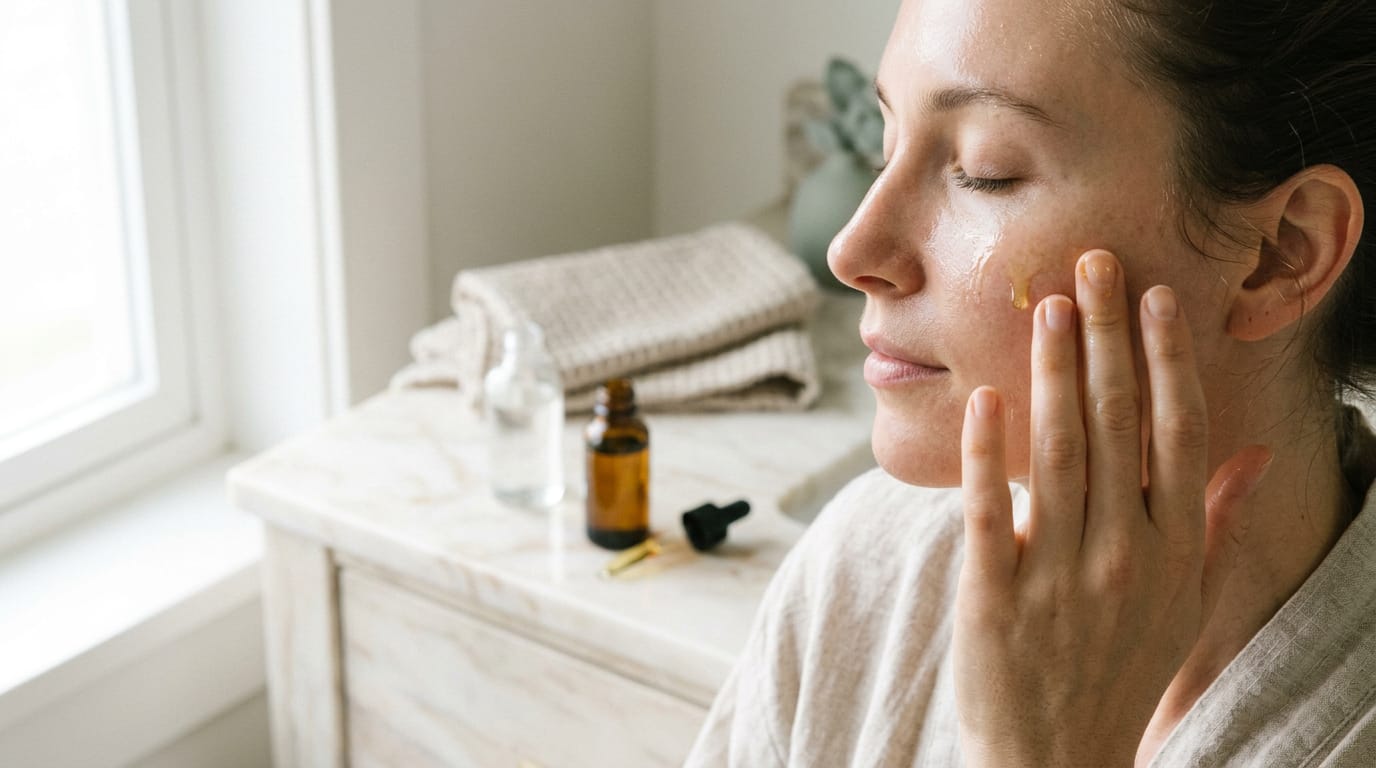
No oil on hand? A slip-rich serum can work in a pinch, so look for a light, slippery texture that won’t drag. A hyaluronic acid serum is another option, though it’s lighter on slip. Oil gives longer-lasting glide.
Serums offer quick slip that fades as they soak in, which can leave you dragging the tool by the end. Oil stays put.
Oils That Work Best for Gua Sha
It’s less about finding the best oil and more about finding the right one for your skin. Here’s how we’d match the most common picks to your skin type and your goal.
Why jojoba suits most skin types
Jojoba oil is often described as resembling your skin’s natural sebum, the oil your skin makes on its own. Because it sits so close to what your skin already makes, jojoba suits most skin types.
The same review ties that closeness to a smoothing effect on dry skin.
It’s also non-comedogenic, meaning it’s less likely to clog pores, and it helps balance oil production. It’s considered hypoallergenic too, so it’s less likely to trigger a reaction.
Think of a bride who wants one oil for her wedding-week routine. A few drops after cleansing give her gua sha tool an easy glide, and one small bottle is all she packs.
Why rosehip helps dry, lined skin
Rosehip oil brings vitamins A and C to the table, which makes it a good fit for dry skin with fine lines, scars or uneven tone. It’s less about covering dryness and more about caring for the skin underneath.
Some skin is sensitive to rosehip, so do a patch test before it goes on your whole face. Dab a little on your jaw or inner wrist and see how it goes. Test first, glow second.
Squalane feels light on oily skin
Squalane is lightweight and non-greasy, and it mimics the natural oils your skin already makes. That makes it a strong match for oily and sensitive skin.
Consider a flight attendant who wants a light oil she can tuck into her bag for long shifts without a greasy feel. Squalane is the one she’d pick.
Argan oil for dry or aging skin
Argan oil is high in vitamin E, and it’s a natural fit for dry or aging skin. It’s also sebum balancing, which makes it a steady choice for readers who want balance. Argan leans toward dry skin, while squalane suits oily skin.
How almond and grapeseed oils differ
Almond oil is the one to reach for when your skin barrier needs repair, the outer layer that helps keep moisture in. It may be thick, so start with just a few drops. Almond is about repair, while grapeseed is the gentler fit for sensitive skin.
Grapeseed is non-comedogenic and antioxidant-rich, meaning it contains compounds that help protect skin from everyday stress. Think of a new mom running on little sleep who wants a calm oil for her reactive skin. Grapeseed is an easy one to try first.
Less common oils worth a look
A few less common oils are worth knowing about:
- Apricot kernel for sensitive skin
- Macadamia, oat, and raspberry seed oils
- Safflower and watermelon seed oils
- Plum, chia, and cranberry blends
- Tamanu and sea buckthorn
Add one at a time so you always know which oil your skin is responding to.
Matching an Oil to Your Skin Type
The goal is fit rather than richness, and the fastest way to find it is to start with your skin type. Here’s how we break down the main groups:
If skin is oily or breaks out easily
If your skin shines by midday or breaks out easily, look for a lightweight, non-comedogenic oil, meaning one formulated so it’s less likely to clog pores.
Squalane, safflower, and grapeseed oils all fit that description, and jojoba also balances oil production.
Picture a bride with oily skin who wants her face to look fresh through the ceremony and the photos. A light oil gives her enough glide for gua sha without weighing her skin down, so she can finish in five minutes and still look like herself.
Richer oils for dry or mature skin
When skin feels tight or looks dull, richer oils like argan and macadamia give you more cushion. Rosehip is a strong pick for dry skin, and plum and chia blends are worth trying when you want a little more richness in one bottle.
A richer oil isn’t better, just different, and it suits drier days.
Gentle picks for sensitive skin
Look for gentle options like oat or apricot oil infused with calendula, and consider jojoba or grapeseed as well. Single-ingredient oils are the easiest to read: if something doesn’t agree with you, there’s only one suspect.
Consider a reader with reactive skin who’s trying gua sha for the first time before her wedding. She starts with one single-ingredient oil, so if her skin protests, she knows exactly which bottle to set aside.
What to look for on the label
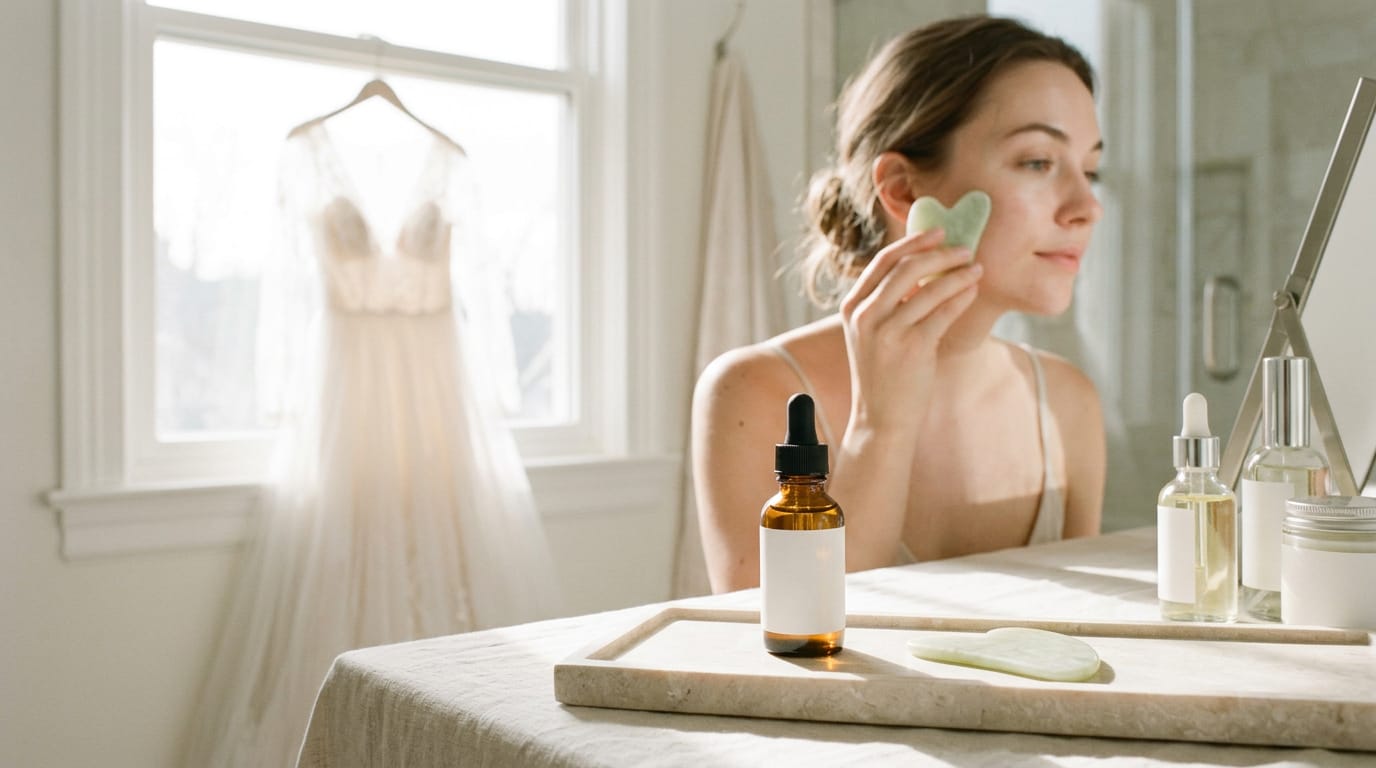
Once you’ve narrowed the field, check the label before you buy:
- Enough slip. The oil should glide under your gua sha tool without dragging.
- Non-comedogenic label. Confirm the bottle says so.
- Vitamin and antioxidant rich. Look for oils that spotlight these on the label.
- Match your skin goal. Pick the oil that fits what you want from it, whether that’s a smooth glide or extra softness on dry patches.
- Label checks. Choose fragrance-free, and look for cold-pressed, meaning the oil was pressed without added heat.
Oils to skip, like coconut and marula
Coconut oil can clog pores. A double-blind, randomized study of the sunscreen Venusia Sun Unseen used it as the positive, comedogenic (pore-clogging) control, so it’s the one to leave off your shelf if you break out easily.
Marula oil is heavy, so it can feel like too much under your tool. Patch-test any new oil on a small area before you use it across your face. Skip the guesswork.
Using Oil During Your Gua Sha Session
Oil goes on after your cleanser and any water-based serum, since the thinnest layers always go first. Here’s how to use it during your session, plus when to schedule it.
Follow these steps, starting with clean skin
Start on cleansed skin so the oil spreads evenly and your tool moves without catching on leftover product. Work through your face in this order:
- Apply a few drops. Warm them between your fingertips, then press them onto your face and neck.
- Stroke upward and outward. Move the tool from the center of your face toward your ears and hairline.
- Cover every area. Work your neck, jaw, cheeks, and forehead.
- Add oil if the tool drags. If it catches, add another drop rather than pressing harder.
Keep it to a light layer. A few drops are usually enough, because the goal is glide rather than slick. Glide, don’t grind.
Consider a bride doing her session the night before the wedding. She warms two drops between her fingers, sweeps the tool from chin to temple, and finishes along her neck. It takes a few minutes, and she’s ready for bed.
Pressure to use and the best time
Use light, gentle pressure. The oil does the work, so your hand only needs to guide the tool.
- Evening: The popular pick, since bedtime gives you a calm window to take your time.
- Morning: Useful for de-puffing before a big day.
Either way, drink a glass of water alongside your session, since water supports drainage.
Picking the Right Gua Sha Tool
The right shape and material decide how easily your tool glides over oiled skin. Here’s what to look for before you buy.
Stones, metals, and shapes that suit beginners
Most beginners do well with a smooth stone or metal tool:
- Rose quartz: a classic, easy-to-find pick with a soft pink tone.
- Jade: a smooth, cool stone many people reach for first.
- Bian stone: a smooth alternative if rose quartz or jade doesn’t feel right.
- Ceramic: smooth and lightweight.
- Stainless steel: sturdy and cool to the touch.
The best tool is the one you’ll use nightly, not the one that looks best on your shelf.
If you’re new to gua sha, go for a heart-shaped tool. Its wide top follows your cheekbones, and its tapered point fits along the jaw and under the eyes. Consider a bride practicing the week before her wedding.
She wants one tool she can glide from cheek to jaw in five minutes before bed, without learning a new grip for each area. By the big day, the motion is second nature. Simple wins.
Skip wood and plastic. They’re harder to keep clean, and that matters when a tool touches your face every night.
Clean it the way you’d clean your makeup brushes: rinse after each session, use a gentle soap, and let it dry fully before storing it.

Staying Safe While Doing Gua Sha
Gua sha is gentle, but it isn’t right for every face on every day. Here’s when to pause, what to expect afterward, and when to get a pro’s help first.
Who should steer clear of gua sha
Hold off on your tool if any of these apply:
- Active breakouts or inflamed skin: Pressing on angry skin only makes it angrier.
- Rosacea: This skin condition causes redness and flushing, so check with your doctor first.
- Blood clot medication: If you take blood thinners, ask your doctor before you start.
- Rash or sunburn: Wait until your skin has fully healed.
Think of a bride with a jaw breakout three days before the wedding. She sets her tool aside and keeps things gentle until it calms, so her skin is ready for photos.
Side effects that can follow a session
Some side effects are temporary, but it helps to know what to expect:
- Bruising and discoloration: Marks or uneven color can appear after a session, and they’re temporary.
- Muscle soreness: Your face or neck may feel sore, like after a long workout.
- Possible breakouts: Gua sha can trigger breakouts on sensitive skin, so watch how yours responds.
- Broken capillaries: Too much pressure can break tiny capillaries (the small blood vessels near the surface of your skin), leaving visible redness.
When in doubt, press less and glide more. Easy does it.
When to see a professional first
If you’re new to gua sha, we’d start with a pro. An esthetician can show you the right angle and pressure on a real face, so you’re not guessing in the mirror.
Some spas offer professional gua sha treatments, a low-stakes way to learn the right pressure before you try it at home.
Make Your Own Infused Oil at Home
Steeping herbs or flowers in a base oil is an easy way to make your own infused oil at home. It’s easier than it sounds.
Herb and flower blends worth trying
Pick one base oil and one botanical to start:
- Rosehip with chamomile: Steep dried chamomile in rosehip oil.
- Almond with rose petals: Add dried rose petals to almond oil.
- Calendula-infused apricot oil: Start with calendula-infused apricot oil, or steep calendula in plain apricot oil.
- Jojoba with ylang ylang: Add ylang ylang to jojoba for a floral finish.
- Argan with helichrysum: Steep helichrysum in argan oil.
- Olive with lavender: Steep lavender in olive oil, then keep it for your bedtime routine.
Heating it fast or letting it steep
Both methods make the same oil. The difference is speed versus patience.
- Double boiler, two hours: Warm the oil and herbs over barely simmering water for two hours, then strain.
- Room temperature, weeks: Seal the herbs in oil, keep the jar cool and dark, and shake it now and then for several weeks.
- Essential oil substitute: If you’re out of dried herbs, a small amount of essential oil can stand in for the herbs. Stir it into the finished oil rather than heating it.
- Patch test, 24 hours: Dab a little on your inner arm before your first full-face use, and wait 24 hours.
Think of a bride who steeps almond and rose oil on a quiet Sunday, then uses that one bottle on her face, hands and hair in the weeks before the wedding. She packs one bottle instead of three. Patience pays off.
Once you understand what the oil is doing, choosing and using one gets simpler. Match the oil to your skin type, keep the layer thin, and pick a tool that feels good in your hand.
Keep it consistent, too, since a few calm minutes most days beat one rushed session.
Your gua sha routine doesn’t have to be complicated to work. A little oil, a smooth tool, and a few minutes you’ll actually look forward to.
References
- Evaluating the non-comedogenic profile of Venusia Sun Unseen: a prospective, double-blind, randomized and controlled study — doi.org (2026)
- The effect of Gua Sha treatment on the microcirculation of surface tissue: a pilot study in healthy subjects — pubmed.ncbi.nlm.nih.gov
- Effects of Gua Sha therapy on perimenopausal syndrome: A systematic review and meta-analysis of randomized controlled trials — pubmed.ncbi.nlm.nih.gov
- Jojoba Oil: An Updated Comprehensive Review on Chemistry, Pharmaceutical Uses, and Toxicity — pmc.ncbi.nlm.nih.gov (2021)
- Gua Sha: Benefits and How To Do It — health.clevelandclinic.org
- The Benefits of Gua Sha: Ancient Technique, Modern Science » San Jose Acupuncture Center — sanjoseacupuncturecenter.com
Questions
What is the best oil to use on your face with a gua sha?
Jojoba is a versatile choice for gua sha because it suits most skin types and is less likely to clog pores. For oily or sensitive skin, lightweight squalane is another good option; choose an oil that lets the tool glide without feeling heavy, and patch-test it first.
Which oil is best for oily skin face?
Squalane is a lightweight, non-greasy choice for oily skin. Safflower and grapeseed oils are also lightweight and less likely to clog pores, while jojoba may help balance oil production.
Can you tell me how to make my own facial massage oil at home?
Choose one base oil suited to your skin and one dried botanical, such as chamomile with rosehip or rose petals with almond oil. Warm the oil and botanical over barely simmering water in a double boiler for two hours, then strain, or seal them in a jar and steep in a cool, dark place for several weeks, shaking occasionally. Patch-test the finished oil on your inner arm and wait 24 hours before using it on your face.
Sources
- The effect of Gua Sha treatment on the microcirculation of surface tissue: a pilot study in healthy subjects - PubMed, pubmed.ncbi.nlm.nih.gov
- Effects of Gua Sha therapy on perimenopausal syndrome: A systematic review and meta-analysis of randomized controlled trials - PubMed, pubmed.ncbi.nlm.nih.gov
- Gua Sha: Benefits and How To Do It, health.clevelandclinic.org
- The Benefits of Gua Sha: Ancient Technique, Modern Science » San Jose Acupuncture Center | Patricia Lambers L.Ac., sanjoseacupuncturecenter.com
- Jojoba Oil: An Updated Comprehensive Review on Chemistry, Pharmaceutical Uses, and Toxicity - PMC, pmc.ncbi.nlm.nih.gov,
- Evaluating the non-comedogenic profile of Venusia Sun Unseen: a prospective, double-blind, randomized and controlled study, doi.org,