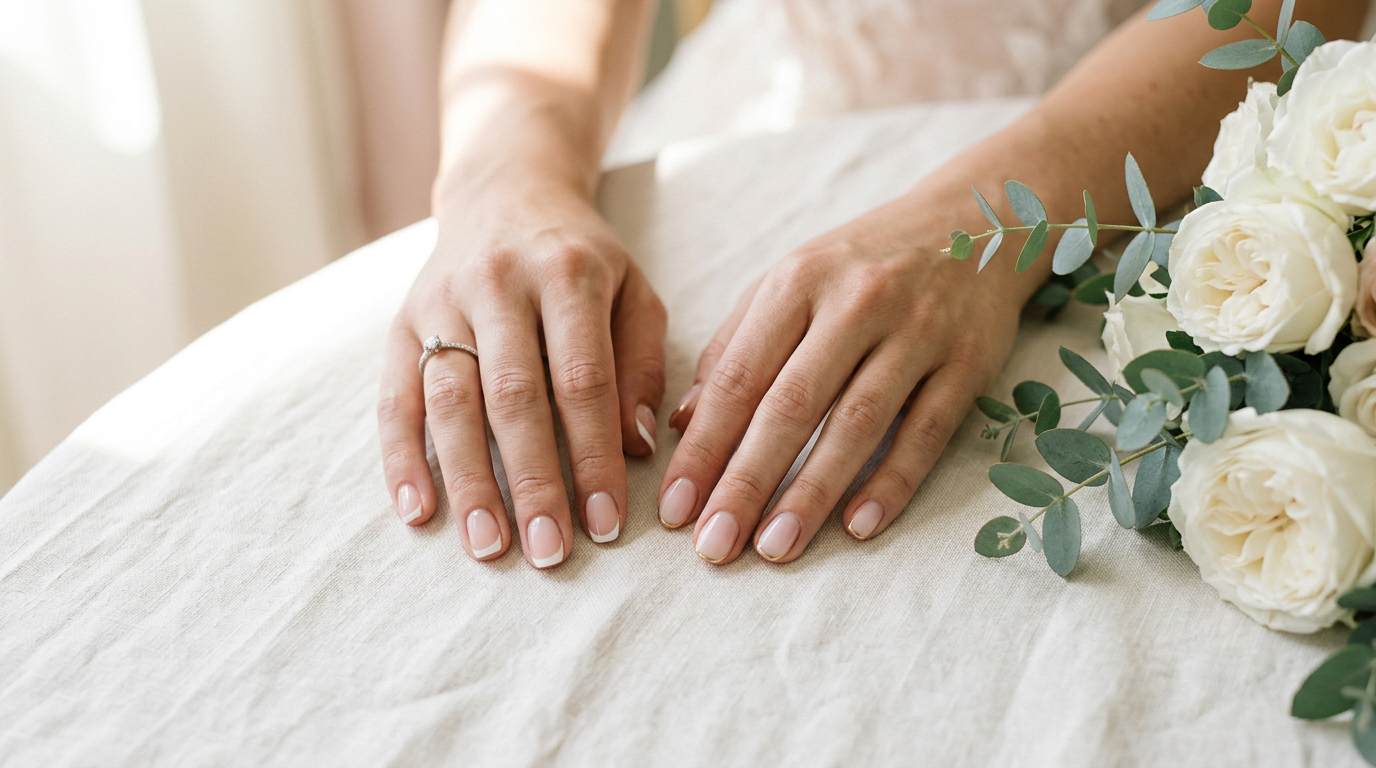
French Nails for Your Wedding: Classic to Modern
French nails for wedding days complement your dress without competing. Compare modern tips, shapes, finishes, plus hand prep and booking advice.

Think of your nails as the accessory that should complement your dress without competing with it. French nails do exactly that: a soft base with a crisp white tip looks polished in every photo and never feels like too much.
The good news is that the classic look still works, and there’s more room in the style than you might expect.
In this guide, we’ll cover classic and modern variations, shape and finishes, matching your nails to the whole look, and booking your tech, plus the hand prep and day-of upkeep that often get skipped.
Classic French Nails for Wedding Days
A classic French manicure is a safe bet for a wedding, but small choices decide whether it looks polished or dated. Here’s what defines it, how tip width changes it, and why it’s back.
What makes a classic French design
Picture a bride who wants polished nails in every photo without a loud look. A classic French gives her that, and it comes down to four parts:
- Base. A nude or pink shade that keeps attention on the tip.
- Tip. A crisp white edge that gives the look its contrast.
- Arc. A clean, even curve, matched across every nail.
- Undertone match. Pick a base that suits your undertone, the subtle warm, cool or neutral tone beneath your skin, so the nails look like they grew from your hands.
How tip width changes the look
Tip width changes the look more than you’d expect. A thin arc looks fresher, while a thick tip can look dated. Keep it slim.
A creamy white reads soft and natural, and a shimmer white adds a little glow.
Here’s how the two widths compare:
| Tip width | How it reads | Best for |
|---|---|---|
| Thin arc | Fresher and more current | A modern, polished finish |
| Thick tip | Heavier, can look dated | A deliberately bold statement |
Why runways and stars love white tips
According to a Marie Claire feature on Zoë Kravitz’s French manicure, the soft, minimal look has always been a favorite among celebrities, and it’s especially having a moment now.
The look has shown up on runways too, including Prabal Gurung’s Spring/Summer 2020 (SS20) show. The white tip is chic again, and that’s good news for brides. Classic and current, all at once.
Why Brides Keep Choosing French Nails
French nails fit almost every wedding and still feel right years later. Here’s why brides keep choosing them.
A style that never looks dated
French nails have been a bridal favorite for decades. A sheer base with a clean white or nude tip stays timeless rather than trendy, so it won’t date the way a bold color can. It’s the little black dress of nails: simple and always appropriate.
The style has even had a comeback, with the 90s look back in fashion.
How they frame your ring in photos
Your hands will be in plenty of photos. A study on religious and secular norms in wedding photography notes that a bride’s hands are featured in many wedding photographs.
A clean tip frames your engagement ring, drawing the eye to the stone and looking polished in close-ups. The nails are there to support the ring, not compete with the diamond.
Think of a bride who moisturizes her hands every night for the week before her wedding. When the photographer asks her to rest a hand near her bouquet, her skin looks as soft as her manicure. Start early, not the morning of.
Easy to match and hard to regret
French nails suit every dress style, from lace sleeves to sleek satin, because the base stays quiet. They also work with all skin tones: pick a sheer pink or soft nude that flatters yours. If you’re still torn, French is the safe choice.
Want something more personal? Try one of these details:
- A thin gold line along the edge
- A tiny stone on one accent nail
- A subtle shimmer over the tip
The base stays classic, and the detail makes it yours.
Newer Takes on the French Look
The classic French look still works, but a few newer versions keep its clean idea and change the details. Here are five directions we’ll walk through:
Ultra-thin lines for a subtle look
An ultra-thin line French runs just 1 to 2 millimeters along the tip. It’s subtle and modern, and it suits a bride who wants polished hands without a bold graphic competing with her jewelry. The goal is a whisper of color, not a shout.
A line this fine needs a precise technician, because every wobble shows. Your wedding band stays the star.
Soft, glazed-looking milky tips
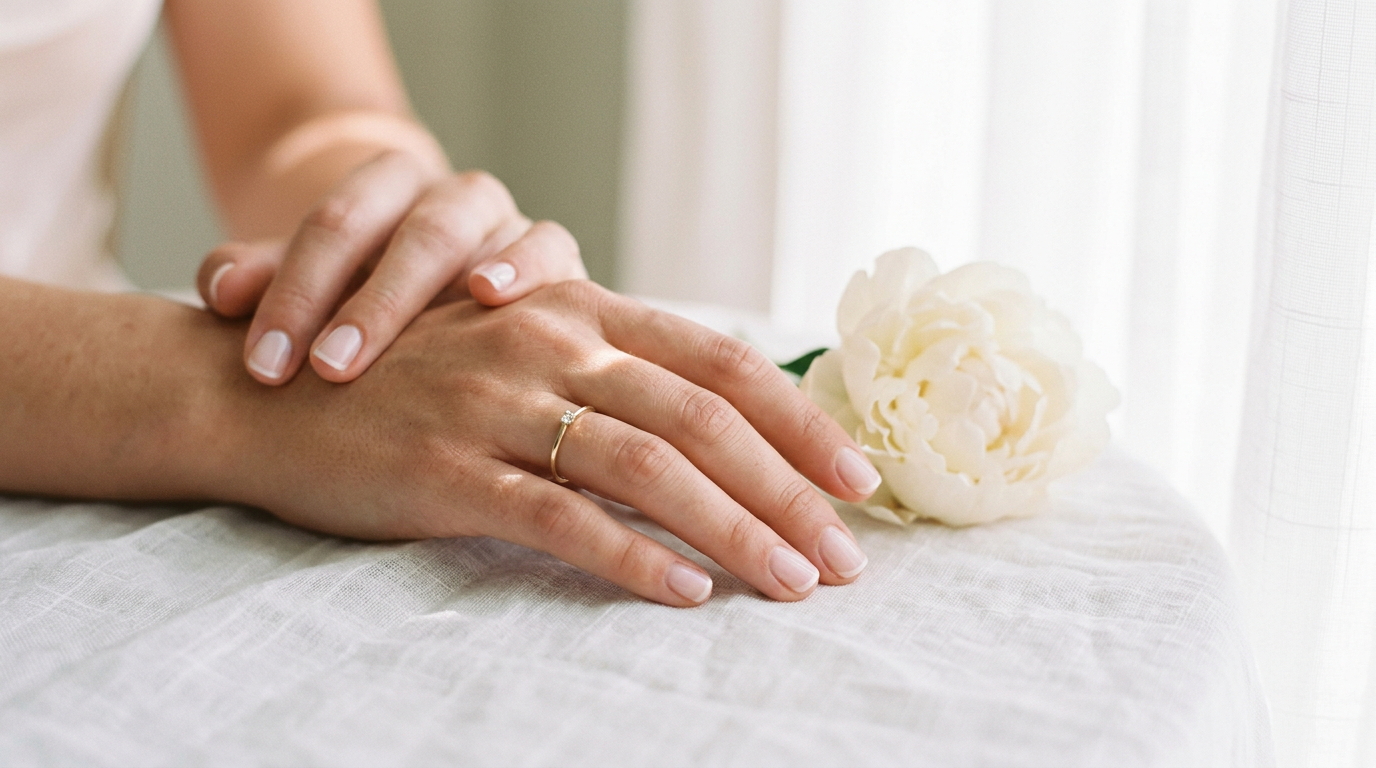
A translucent creamy base is a sheer, milky color that lets your natural nail show through. The tip blends softly into it rather than ending in a hard edge, for a luminous, glazed look. It works on short nails, since there’s no line to crowd the tip.
Consider a bridesmaid who keeps her nails short for work but wants a finish that looks intentional in the group photos.
A seamless fade from nude to white
A seamless fade moves from nude to white with no harsh line. It’s a blend, not a border, so it’s forgiving of imperfections: a slightly uneven tip melts into the gradient.
The catch is that the sponge technique takes skill, so leave it to a technician who does it well. Picture a bride who’s nervous about every close-up. A soft fade gives her a finished look without a line that has to land perfectly.
Offbeat twists like reverse or double lines
These keep the French structure but play with it. A reverse cuticle crescent places the crescent near the cuticle instead of at the tip, and double tipped lines use two thin lines along the edge instead of one. Both stay minimal yet offbeat.
They change where the line sits, not whether there is one. Imagine a maid of honor whose dress is already busy with lace: a minimal reverse crescent adds a detail without competing with the fabric.
Colored and metallic tip ideas to try
Color moves onto the tip, but the shape stays French at heart. Four options to consider:
- Something blue tips: a soft blue tip is a subtle nod to the ‘something blue’ tradition.
- Black and white graphic: a bold, high-contrast tip that makes a strong statement.
- Gold-line French: a fine metallic gold line along the tip that echoes gold jewelry.
- Blush or lavender tips: soft pastel tips that feel romantic and light.
A bride matching her nails to her bouquet gets a lot from a blush tip: it echoes the flowers, and the color stays on the tip, not across the whole nail.
Add Shine with Finishes and Accents
A classic French can carry a little shine or a personal detail without losing its clean edge. We’ll walk through the finishes you can add and which suit a wedding best.
A soft glow from pearl overlays
A pearl overlay is a sheer, milky layer brushed over the tip or base of the nail for a luminous glow. Don’t overdo the shimmer: one thin coat reads polished, while heavy sparkle can look like a costume.
Tiny pearl accents on one or two nails work well too. Consider a bride who wants her hands to glow in close-up shots of her ring, and a pearl tip gives her that light without stealing focus. Subtle wins.
Chrome tips that go soft or mirror
Chrome powder is a fine metallic dust buffed over the tip for a reflective finish. Gold or rose gold chrome adds warmth. For most bridal looks, choose soft chrome over mirror, which can feel loud in photos.
Metallic tips sit in between, with more sparkle than soft chrome but less than a mirror. Consider a bridesmaid holding a bouquet through hours of photos. Soft gold chrome still looks polished when she reaches for her drink.
Fine glitter tips that hide chips
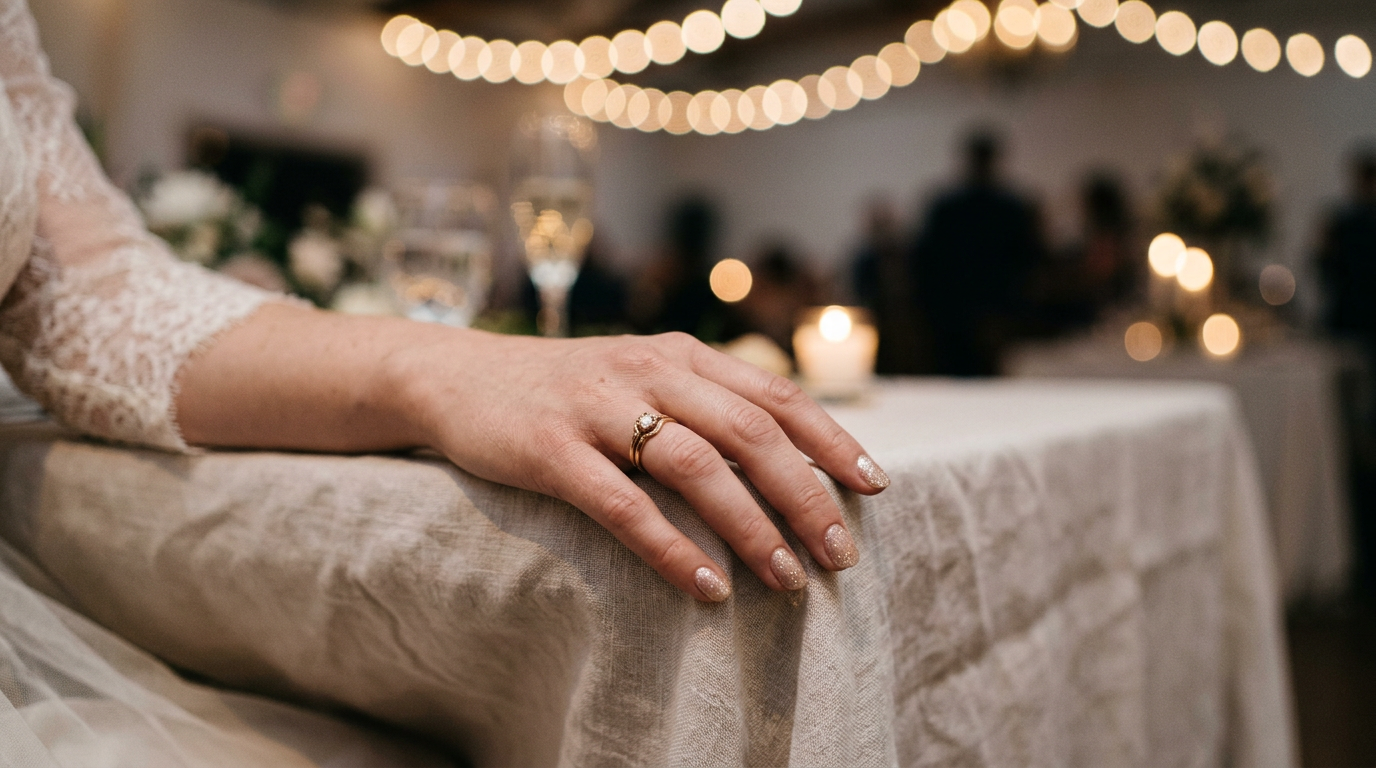
Choose fine glitter, not chunky flakes. Fine particles read as shimmer, while chunky pieces stand out in photos. Silver, gold, champagne, and iridescent all work, so match your metals and dress.
Glitter also hides chips, so a small nick won’t show the way it would on plain white. It’s a smart pick for evening weddings.
A bride staying late at the reception can wear champagne glitter under string lights and skip the touch-up kit even after hours on the dance floor.
Lace, crystal, heart or cloud art
Keep the art small so the manicure still reads as classic French. Consider a bride whose gown has lace sleeves. Her nails can echo that detail in a few ways:
- Lace art echoes the dress. Paint a delicate pattern on one or two nails.
- Crystal accents add sparkle to a single nail, such as the ring finger.
- A French lace manicure runs a fine lace motif along the tip for a romantic look.
- Heart or cloud designs suit a whimsical or garden wedding. Keep them minimal so the look still reads as French.
Picking the Right Shape and Length
Shape frames your French tip, so choose the one that suits your hands, not the one that looked best on a shop display. Here’s how to match a shape to your fingers and your dress.
Almond and oval shapes that elongate fingers
If you want the most elegant result, go with an almond or oval shape. Both give you a tapered tip line that flows from the nail bed to the edge, and that line elongates fingers in a way blunt shapes don’t.
Keep the length at medium, since that’s the sweet spot for most hands. Oval and almond are timeless, so they’ll look right in photos for years.
Making French work on short nails
Short nails don’t have to skip French. Think of a bride whose nails stay short after a busy spring at work. A micro French, a very thin white line along the tip, gives her a polished look without added length.
It’s practical and comfortable, with little to catch on tulle or lace. Avoid thick tips, which swallow a short nail and make it look stubby. Thin tips win. Keep the line slim so your ring takes center stage, not your manicure.
Square and coffin shapes, but skip stilettos
For crisp, defined lines, choose a square tip with straight edges and clean corners. It suits structured gowns, like a tailored sheath. The coffin shape, squared at the tip with tapered sides, works at medium length, not long.
Avoid extreme stiletto shapes. They’re tricky to live with through a day of hugs and bouquet tosses, and they can overpower a classic gown.
Matching Your Nails to the Whole Look
Your French tip should work with everything else you’re wearing, from the dress to the venue. Here’s how to pull it together without overthinking it.
Pairing nails with your dress and jewelry
Start with the gown. Lace has its own pattern, so keep your tips clean. Satin’s sheen pairs well with a soft, sheer base, and with sequins, let the dress do the sparkle.
Pearls suit a milky base and a thin white tip, while gold looks warmer on a champagne or nude base.
An ivory gown looks softest with a creamy base, while a bright white dress calls for a crisper tip. Match the tone, not just the shade name.
Your nails should complement the look, not compete with it. Let the dress lead.
Consider a bride in a sequin gown and pearls. A sheer nude base with a classic white tip keeps her hands polished in photos without fighting the sparkle.
Choosing nails by venue, season and theme
A ballroom or church wedding suits a classic French tip with sharp lines and a base close to your skin tone.
For a winter evening, a touch of glitter in the tip catches the candlelight. Autumn calls for warm gold tones, like a golden-beige base. A minimalist city wedding works best with a short, clean tip on a barely-there base.
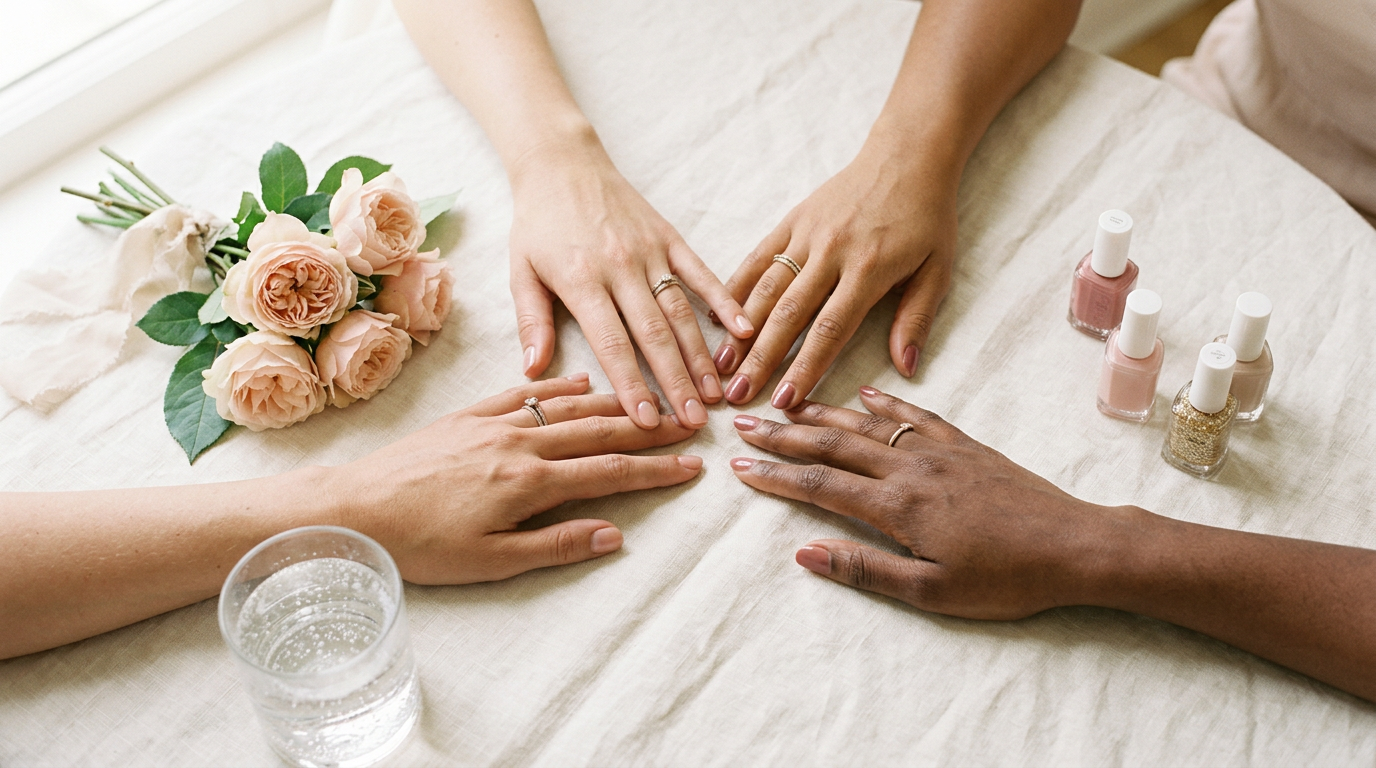
Bridesmaids and mothers don’t need identical nails. Share one soft color, like a sheer rose, and let each woman’s skin tone guide the shade.
For example, a bride’s mom might wear a deeper rose while her bridesmaids choose sheer nude, and the group still reads as one team in photos.
Booking Your Tech and Prepping Your Hands
Booking and prep deserve as much planning as the design, so here’s how to get both right.
Working well with your nail technician
Bring reference images, pick the tech for skill rather than the lowest price, and check recent French sets for clean lines and even tips.
Choose the design early, including the material, so your tech can plan. You’ll usually pick from three options:
- Gel: cured under a lamp for a glossy, flexible finish.
- Acrylic: a powder-and-liquid mix that adds strength and length.
- Press-ons: ready-made nails glued on, handy as a backup.
Lace art is a specialty, so book a tech who does it regularly.
Consider a bride who wants soft pink French tips with a fine lace detail. She brings three photos, books a tech with recent lace work, and walks down the aisle with no lifted tips.
Book early for a wedding weekend, and schedule the final set a few days before the big day. Ask for pricing up front, since lace and pearls usually add to the cost.
Prep steps for the weeks ahead
Start with a trial manicure a few weeks out. It’s a dress rehearsal for shape and color in daylight, so you can request changes without pressure.
Moisturize your cuticles and hands daily with cuticle oil, and in the weeks before, avoid picking at cuticles and wear gloves for chores.
Adding pearls? Ask for builder gel to secure them, a sturdy gel that keeps accents in place through the toasts.
Ask for a glossy top coat for a polished sheen in photos.
Finally, pack a chip touch-up kit:
- a bottle of your exact shade
- a fine brush
- a mini file
If a tip catches on your veil, you’ll fix it fast.
When Another Style Suits You Better
Not every bride wants a French tip, and that’s fine. Here’s how we’d narrow it down.
Pick a style that feels like you
Start with your overall look:
- Maximalist brides may prefer nail art, since a plain tip gets lost next to a detailed look.
- Bold color palettes suit a wedding that’s already rich in color.
- Choose what looks like you rather than what’s trending.
- Avoid regrettable trend choices by asking whether you’ll still love it when you flip through your album years from now.
Consider a bride in a sculptural gown with a jewel-toned bouquet. A plain French tip would look like an afterthought beside all of that, so a deep berry base with one hand-painted accent nail suits her better.
In every photo, her hands match the rest of her day. Fit beats trend every time.
Are French tips good for weddings?
Yes, and the numbers back it up.
According to The Knot, cited in a roundup of almond French tip designs, the classic French manicure on almond nails is the #1 most-requested bridal nail look for US weddings, appearing on over 60% of wedding nail inspiration boards pinned each year.
That same research pairs the classic look with almond nails, so it’s a sensible place to start if you’re choosing a shape.
A milky French swaps the crisp white tip for a sheer, soft white. Think crisp for a classic tip that shows clearly, and soft for a milky finish that reads more like your natural nail.
The best wedding nails aren’t the most dramatic ones. They match your dress, hold up through the ceremony, and still look fresh in the final photos.
Whether you choose a classic tip, a newer twist, or a different style, the right pick comes down to your hands, your timeline, and how you want to feel.
Book early, prep your hands ahead of time, and pack a simple touch-up kit for the day. A good manicure is the one you forget about by the first dance.
References
- For Ever and Ever the Perfect Wedding Picture: Converging Religious and Secular Norms and Values in Wedding Photography — mdpi.com (2024)
- Zoë Kravitz Is Giving the French Manicure an “Invisible” Twist — marieclaire.com (2026)
- Almond French Tip Nails: 20 Designs from Classic to Trendy — shangmengnails.com (2026)
Sources
- Zoë Kravitz Is Giving the French Manicure an "Invisible" Twist | Marie Claire, marieclaire.com,
- Almond French Tip Nails: 20 Designs from Classic to Trendy – SHANGMENG nails, shangmengnails.com,
- For Ever and Ever the Perfect Wedding Picture: Converging Religious and Secular Norms and Values in Wedding Photography, mdpi.com,