Can Stress Cause Hair Thinning? What Shedding Means
Can stress cause hair thinning? See how stress shifts strands into shedding, how long recovery may take, and when to talk with a doctor if shedding persists.

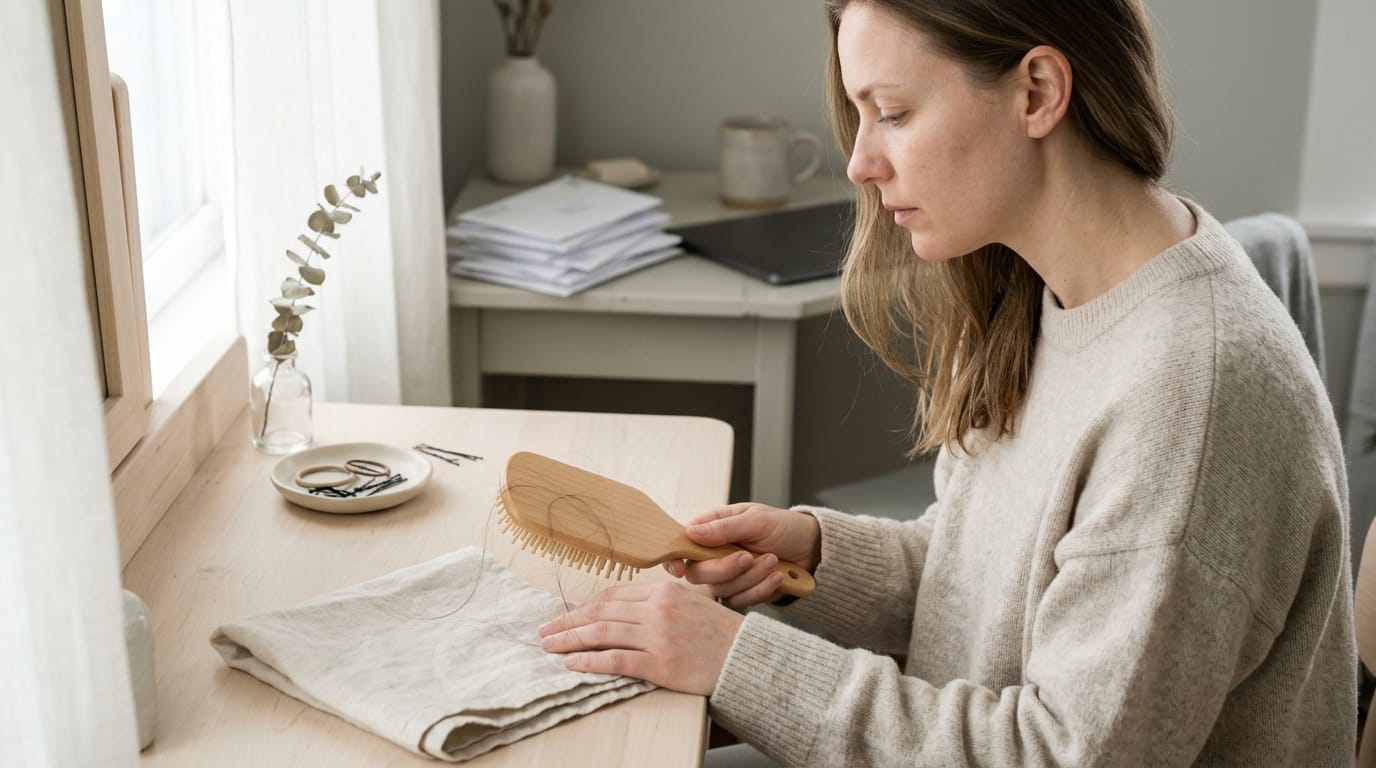
Ever pull a handful of strands off your brush after a rough month and wonder if stress is to blame? Think of your hair like a garden with its own seasons: some strands grow, some rest, and some are ready to let go.
Stress can push more strands into that shedding stage, so your part or ponytail may look thinner than usual.
We’ll explain how stress thins hair, what the different types of shedding mean, how long recovery takes, when to see a doctor, and a light routine that keeps hair looking its best.
How Stress Can Cause Hair Thinning
Yes, stress can thin hair, but rarely in the way people expect. Here’s how we break it down.
Telogen shedding that starts months later
Stress can push follicles into the resting phase, which causes telogen shedding (medically, telogen effluvium). Shedding shows up months after the stress, not during it.
A literature review on telogen effluvium reports that hair loss generally occurs two to three months after the trigger exposure.
You’ll notice it when you comb or wash: more hair on the brush or in the drain. It’s diffuse, spread across the scalp, and usually temporary: it resolves on its own once the stress passes.
Recovery runs in order: shedding first, then regrowth, and the regrowth stretch is the slow one. Give it time.
Picture a bride who spent last year juggling a demanding job and wedding planning. Months after the ceremony, she finds strands on her sweater. Knowing the delay lets her skip the panic and keep her routine simple.
Other conditions tied to stress
Trichotillomania is a condition in which a person compulsively pulls out their own hair. Alopecia areata is an immune attack on hair follicles.
Cortisol, the body’s main stress hormone, also comes into play with pattern hair loss, the gradual thinning that follows a predictable pattern.
Perimenopause, the years leading up to menopause, has its own causes, and stress may be only one piece of the picture. If your thinning started then, bring it to your doctor rather than assuming stress is the whole story.
What stress does inside the body
Stress reaches follicles in four ways:
- Cortisol disrupts the growth cycle, nudging follicles out of rhythm.
- Blood flow to the scalp drops, leaving follicles with less to work with.
- Inflammation can damage follicles over time.
- Nutrient availability can decrease, so follicles get less fuel.
Individual and genetic variation means the same stressful year can hit two people differently.

What counts as a stressor
A stressor doesn’t have to be a crisis. Any of these can count:
- Emotional stress and grief, such as losing someone close.
- Chronic stress, the long, low-grade kind that keeps your body in fight-or-flight mode.
- Physical stress, like childbirth or surgery.
- Illness and weight loss.
Ways to Prevent and Recover from Thinning
Recovery comes down to daily habits, a treatment that suits you, and knowing when to call a doctor. Here’s what we’d suggest.
Lowering stress with daily habits
Small habits add up. Start with one.
- Exercise regularly. A brisk lunchtime walk counts.
- Meditation, yoga, or deep breathing. Two slow breaths before you reach for your phone can help.
- Enough sleep. Treat it as a priority, not a bonus.
- Talking to trusted people or professionals. Hair loss can feel personal. Say it out loud to a friend or partner, or ask a professional if the worry lingers.
- Evening wind-down. Think of a bride who swaps late-night scrolling for a ten-minute routine: lights low, face cleansed. By the big day, she’s sleeping more soundly.
Treatments that help hair grow back
Hair may grow back, so give treatment time. According to a CMAJ article on female pattern hair loss, topical minoxidil is a first-line treatment, available as a 2% solution used twice daily or a 5% foam used once daily.
The same article also names oral spironolactone as first-line.
- Thickening shampoo. It can make strands look fuller while you recover.
- Sprays and fibers. They hide thinning, so use them as a bridge while you aim to recover, not just cover.
- Gentle, light scalp care. Keep it simple: a mild shampoo, conditioner on the lengths, and a soft scalp massage. A new mom can do this in a few spare minutes.
When to see a doctor
- Sudden or patchy hair loss. Don’t wait: see a doctor soon if hair falls out quickly or in patches.
- Possible underlying medical condition. Thinning can point beyond stress, so don’t assume stress is the only cause.
- Consult your provider before new treatments. Check in before starting minoxidil, spironolactone, or anything new.
- Tests doctors use. Doctors often check iron and thyroid levels, so ask about both.
Foods and Supplements for Healthier Hair
What you eat can support healthy hair, but food is a foundation, not a fix.
Nutrients that matter most for hair
Hair is built largely from protein, so the basics count:
- Vitamins B, C, D, and E. Aim for steady daily intake from food, not one bottle.
- Iron, zinc, and selenium. Get these from meals first.
- Protein and omega-3 fatty acids. Omega-3s are the fats found in fish and nuts.
- Biotin. A B vitamin common on supplement labels.
Consider a bride three months out who’s running on coffee and skipping meals. Her first fix isn’t a new bottle. It’s one protein-rich lunch a day, with nothing new on the counter.

Foods and eating habits that help
Three habits are worth building in:
- Salmon, walnuts, and leafy greens. Salmon and walnuts bring omega-3s, and leafy greens add more of the nutrients above.
- A balanced, varied diet. Rotate proteins, veggies, and grains. Variety beats perfection.
- Limit processed and sugary foods. Fewer packaged snacks leave more room for the good stuff.
It’s a steady pattern, not a quick fix.
What research says about supplements
Hair supplement research is still thin.
According to a hair-loss vitamins guide from Acibadem International, a 2022 systematic review (a study that pools many trials) in the Journal of the American Medical Association (JAMA) Dermatology rated most evidence for hair supplements as low certainty, with small, short, often industry-funded trials.
A scoping review in the Journal of Cosmetic Dermatology looked at omega-3 and omega-6 fatty acids with antioxidants as supplements for hair loss.
According to CVS’s guide on whether stress causes hair loss, a 2022 review of more than two dozen studies found a few options that seemed promising: zinc, pumpkin seed oil, and capsaicin, a compound from chili peppers.
Talk to your provider before you start any supplement. Ask first, then add.
Other Causes and Habits That Hurt Hair
Stress isn’t the only culprit. Other causes and everyday habits can thin hair too.
Common reasons hair falls out
Hair loss comes in a few main types, and the cause usually tells you which one you’re dealing with. Pattern hair loss runs in families and shows up as gradual thinning.
Shedding tied to hormones or illness tends to spread across the scalp, while scalp infections stay localized.
- Genetics and pattern baldness. A family history of thinning is a strong clue to what your own hair may do.
- Aging and hormones. Hair thins with age, and hormone shifts from pregnancy or menopause can make shedding more noticeable.
- Medical conditions and medications. Thyroid problems, low iron, and some prescriptions can cause shedding, so don’t change a prescription without asking your doctor.
- Scalp infections. Fungal infections and other scalp conditions can inflame follicles, so getting them treated gives hair its best chance to recover.
Consider a new mom who finds clumps in the shower a few months after her baby arrives. Knowing that shedding after childbirth is often temporary keeps her routine short instead of sending her shopping for three new products.

Habits that add to hair loss
- Poor diet. Crash dieting or skipping protein starves hair of the nutrients it needs.
- Smoking reduces blood flow. It narrows blood vessels, which can cut the nourishment reaching follicles.
- Heat and chemical styling. Frequent blow-drying and harsh bleach can weaken strands until they snap.
- Tight hairstyles. Ponytails and buns that constantly pull can cause traction hair loss from steady tension.
- Pollution and oxidative stress. Smog and sun can build up on the scalp and cause oxidative stress, a cell-damaging imbalance.
Most of these habits depend on how often you do them, so small changes add up. Turn down the heat and loosen that bun. Fewer hot tools, healthier strands.
How Stress Affects Gray Hair
Stress and gray hair are more connected than most of us realize. Here’s what’s happening at the root, and how you can decide what to do about it.
Why stress speeds up graying
Hair gets its color from melanocytes, the cells in each follicle that produce pigment. Those pigment-making cells are supported by melanocyte stem cells, which contribute to hair pigmentation.
Under stress, that process gets disrupted. Nerves that reach into each follicle release norepinephrine, a chemical messenger that gets taken up by nearby pigment-regenerating stem cells.
According to Harvard Stem Cell and Regenerative Biology (HSCRB), that chemical can deplete melanocyte stem cells, leaving less support for pigment.
So under stress, graying can speed up. Fewer stem cells, faster silver.
Hiding or embracing gray hair
Gray hair is often considered permanent and irreversible, so the choice usually comes down to two paths: embrace it or conceal it.
It’s less about fixing gray and more about choosing the look you want. Embracing it means letting the silver show and styling around it. Concealing usually means permanent dye, which colors gray strands directly.
Think of a bride who spots a few new silver strands near her part three weeks before the wedding. She can book a color appointment for a quick touch-up, or decide the silver looks right and keep that time and money for something else.
Either way, she walks into her week of events feeling like herself.
Stress can thin hair by pushing more strands into a resting, shedding phase, and for many people that hair recovers with time and steady care. Hair grows on its own schedule, so patience is part of the process.
Keep your routine light: a gentle wash, one or two layers that do real work, and less pulling and heat. If the shedding persists or worries you, see a doctor instead of adding another bottle.
Your hair is more resilient than it feels right now, so give it calm, consistent care and let it grow back at its own pace.
References
- Omega Fatty Acids in Hair Loss Disorders: A Scoping Review of Preclinical and Clinical Evidence - Abdul‐Rahman - 2026 - Journal of Cosmetic Dermatology — onlinelibrary.wiley.com (2026)
- Female pattern hair loss — cmaj.ca (2026)
- Telogen Effluvium: A Review of the Literature — pmc.ncbi.nlm.nih.gov
- Solving a biological puzzle: How stress causes gray hair — hscrb.harvard.edu
- Hair Loss Vitamins: Real Deficiencies vs Marketing Hype — acibademinternational.com (2026)
- Can stress cause hair loss? — es.cvs.com (2025)
Questions
What is telogen effluvium?
Telogen effluvium is temporary, diffuse hair shedding that occurs when more follicles than usual enter the resting phase of the hair-growth cycle. It often appears two to three months after a trigger such as stress, illness, childbirth, or weight loss, and shedding usually eases once the trigger passes.
What are the best treatments for female hair loss?
Treatment depends on the cause. For female pattern hair loss, topical minoxidil is a common first-line treatment, and oral spironolactone may also be considered with a clinician; correcting issues such as low iron or thyroid problems can help when they contribute. Gentle hair care and thickening products can support appearance, but check with a healthcare provider before starting medication or supplements.
What are the different types of hair loss?
Common types include pattern hair loss, diffuse shedding such as telogen effluvium, alopecia areata, traction hair loss from repeated pulling, and hair loss caused by scalp infections or other scalp conditions. Hair can also break from heat or chemical damage, which is different from shedding from the follicle. The cause and pattern help determine the right treatment.
What are some effective tips for controlling hair fall?
Use a gentle shampoo, avoid frequent high heat and harsh chemical treatments, and loosen hairstyles that pull on the hair. Eat a balanced diet with adequate protein and avoid crash dieting; regular sleep, exercise, and stress-management habits may also support recovery. See a doctor for sudden, patchy, persistent, or concerning hair loss.
How to deal with hair loss mentally?
Hair loss can feel upsetting, so talk with someone you trust or a mental health professional if worry or distress lingers. Focus on manageable habits, such as a simple hair-care routine and stress-reducing activities, rather than repeatedly trying new products. A doctor can help identify the cause and discuss treatment options.
Can stress cause alopecia?
Yes. Stress can trigger telogen effluvium, a temporary, diffuse shedding that typically becomes noticeable two to three months after the stressful event. Stress may also be associated with trichotillomania and can contribute to other patterns of thinning, but sudden or patchy loss should be assessed by a doctor.
What causes hair loss during perimenopause?
Perimenopause brings hormone changes that may make thinning more noticeable, and aging and genetic pattern hair loss can also play a role. Stress may contribute, but it is not necessarily the only cause; thyroid problems, low iron, medications, and other health factors can also lead to shedding. A clinician can help evaluate the cause.
Sources
- Telogen Effluvium: A Review of the Literature - PMC, pmc.ncbi.nlm.nih.gov
- Solving a biological puzzle: How stress causes gray hair | HSCRB, hscrb.harvard.edu
- Hair Loss Vitamins: Real Deficiencies vs Marketing Hype, acibademinternational.com,
- Omega Fatty Acids in Hair Loss Disorders: A Scoping Review of Preclinical and Clinical Evidence - Abdul‐Rahman - 2026 - Journal of Cosmetic Dermatology - Wiley, onlinelibrary.wiley.com,
- Can stress cause hair loss?, es.cvs.com,
- Female pattern hair loss | CMAJ, cmaj.ca,