
Peptides for Skin Explained: How They Work and Why
Peptides for skin can feel like another bottle; learn which types to look for, how they work, and how to fit them into a five-minute routine safely.

Think of your skincare shelf like a closet full of clothes you rarely wear. Every new bottle promises something better, yet you still reach for the same two items each morning.
Peptides can feel like one more thing to add, so it’s worth knowing what they actually do.
In plain terms, peptides are short chains of amino acids, the small building blocks that make up proteins. In this post, we’ll cover what they do for skin, the main kinds you’ll see on labels, and how to fit them into a routine that takes five minutes.
Peptides for Skin and How They Work
If you’ve seen peptides on a serum label and wondered what they’re doing there, you’re in good company. Here’s the basic picture, from how your body makes them to how skincare brands make their own.
The basic biology behind peptides
Peptides are short chains of amino acids, the small building blocks that link together to form proteins. Think of amino acids as beads: string a few together and you have a peptide, string many together and you have a protein.
Your body makes peptides naturally, but production slows as you age.
How peptides signal skin cells
Peptides act as messengers, telling skin cells what to do. Their jobs include:
- Boosting collagen and elastin, the proteins that keep skin firm and springy
- Supporting skin repair
Their small size also aids penetration into the skin.
A systematic review of oral and topical peptides for skin aging notes that topical peptides have to get past the skin’s outer barrier, and how well they do depends heavily on size, along with other factors. Size really does matter.
Consider a bride who keeps a peptide serum next to her toothbrush and uses it every night through months of wedding planning. That’s one bottle instead of three, and a steady signal for her skin to keep up its repair work.
Body-made versus lab-made peptides
The peptides your body makes are the originals, produced naturally inside your skin. Skincare brands make their own in a lab, which shifts the question from whether peptides work to how they get where they need to go.
Lab-made versions are designed for deeper penetration. According to a systematic review of skincare peptide developments, their amino acid makeup can be altered to improve stability and activity. Tuning is the point.
What Peptides Do for Your Skin
Peptides are signaling molecules that send messages to skin cells. Here’s what they’re meant to do, and how strong the evidence is.
Do peptides tighten loose skin?
Short answer: peptides can support a smoother, firmer look, but they won’t lift sagging skin. In one clinical trial of a peptide, crow’s feet and forehead wrinkles showed significant reductions.
A 56-day study of 31 participants found elasticity up 12.5% and firmness up 20.7%.
Collagen is the protein that gives skin much of its structure. A Frontiers systematic review describes peptides as stimulating collagen synthesis, or the making of new collagen.
Peptides are also aimed at countering age-related collagen loss, the slow decline in that protein over time.
Think of a bride who starts a peptide product months before the wedding, hoping her eye area looks smoother in the photos. The 56-day study is a reminder: this takes weeks, not a same-morning fix. Expect support, not miracles.

Helping skin heal and guard its barrier
Peptides are also linked to repair and protection:
- Wound healing. They’re meant to speed up the repair of damaged skin.
- Protecting the upper layer. They’re also meant to guard the skin’s outermost layer.
- Barrier function. That barrier holds moisture in and keeps irritants out, and peptides are meant to strengthen it.
- Inflammation. They’re also meant to calm inflammation, the redness and irritation that make skin feel reactive.
Moisture, plumpness and a more even tone
Peptides are linked to better moisture retention, so skin holds water and can look plumper. Melanin, the pigment behind skin color, is the target when you’re working on tone.
A research overview calls biologically active peptides a promising category that can reduce melanin synthesis with minimal side effects. That pigment is behind hyperpigmentation, or patchy darker spots.
A topical alternative to injectables
Peptides are a topical option, so they’re non-invasive: you apply them yourself, with no needles involved.
A review of acetyl hexapeptide-8, often called a ‘botox-like’ peptide, points to its potential to reduce wrinkles by influencing nerve-to-muscle signals.
The reference point is Botox, the injectable that relaxes muscles, so the goal is a Botox-like muscle relaxation effect on the movement behind some lines. The word to watch is potential, not proof.
The Main Kinds of Peptides
Think about what a peptide is built to do, not just the name printed on the box. Here’s how we sort the main families you’ll see on labels, and which concern each one tends to target.
Collagen-boosting peptides for mature skin
These are the peptides most often chosen for mature skin. They’re designed to stimulate collagen and elastin, the proteins that give skin its structure and bounce. Two names to look for are Matrixyl 3000 and Syn-Coll.
If your skin has lost some of its firmness over the years, this is the family to start with.
Peptides that deliver copper for repair
Some peptides deliver minerals like copper to the skin. One example is the copper peptide GHK-Cu, and this family is all about repair and healing. Think of it as the option for skin that needs help recovering.
Peptides that block collagen-breaking enzymes
These peptides work by blocking collagen-degrading enzymes, the proteins that break collagen down. Where the first family works to stimulate collagen, this one works to protect what’s already there, which is how it helps preserve firmness.
It’s also linked to controlling hyperpigmentation, the dark patches and uneven tone that can show up on skin.
Peptides that relax expression lines like Botox
Some peptides can have a Botox-like effect on expression lines, the creases that form when you smile, squint or frown. Think of a bridesmaid who squints through every group photo and wants the lines between her brows to look softer.
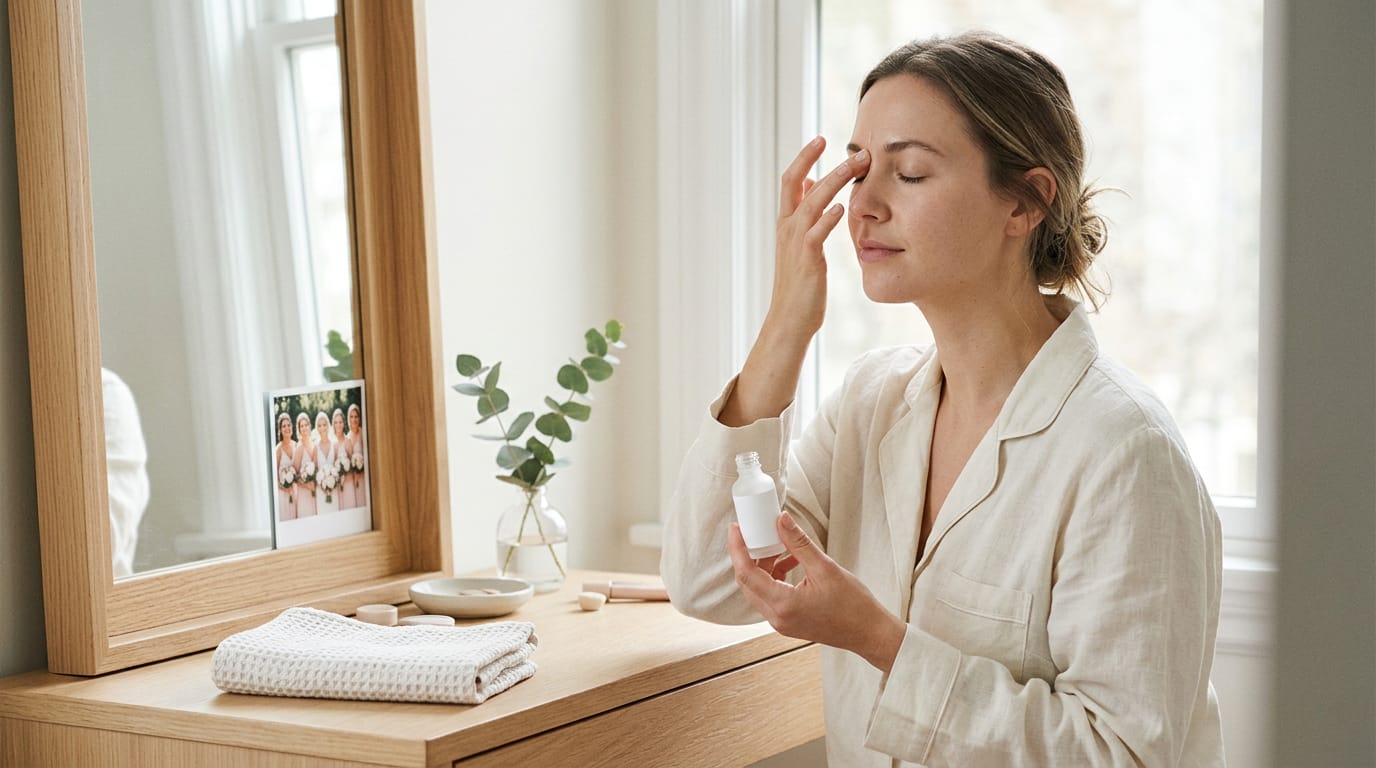
A serum from this family is a simple way to build that softening into her five-minute routine.
Look for these names on the label:
- Argireline (acetyl hexapeptide-8)
- Acetyl hexapeptide-30
According to a review of acetyl hexapeptide-8, it inhibits acetylcholine release, a chemical signal that tells your muscles to contract.
That reduces facial muscle contractions and effectively decreases the appearance of expression lines. Less movement, softer lines.
Multitasking peptides that support skin structure
Not every peptide has just one job. Keratin and other structural peptides help support the skin’s structure, and they also help improve the skin barrier, the outer layer that holds moisture in, and support water retention.
Many products blend several peptide types into one formula, known as multi-concern blends. If you’re juggling a few goals at once, like firmness and a dry, tight feeling, one of these can cover more than one in a single bottle.
Check the label for the peptides inside. Fewer bottles, more coverage.
Choosing and Using Peptides for Skin
Which peptide do you need, and where does it go? Here’s how to decide.
Match peptides to your main concern
Start with your main concern, then choose a peptide product labeled for it. Consider a bride with sensitive cheeks who wants her skin to look rested in photos. She patch tests one leave-on serum and skips the extra layers.
If you’re pregnant or have sensitive skin, check with your doctor or pharmacist first. Choose a leave-on formula, since rinse-off products give peptides little time on skin. Look for opaque, airtight packaging that protects the formula.
Many peptide names include the word ‘peptide,’ so scan the full ingredient list, not just the front label. As for timing, we don’t have a verified timeline, so judge a product by consistency rather than speed.
Where peptides fit in your routine
Peptides go after cleansing and before moisturizer:
- Cleanse. Use a gentle cleanser.
- Apply your peptide. Smooth a thin layer over clean skin.
- Moisturize. Finish with your usual moisturizer.
Professional microneedling creates microchannels with tiny needles, and a University of Southern Denmark study notes they can boost how well peptides penetrate the skin.
That depends on whether a practical protocol can reliably create them, so ask your esthetician whether it’s part of your plan.
That’s a complete light routine. Picture a new mom with ten minutes and one sink: she cleanses, applies her peptide, moisturizes, and she’s out the door.
Which ingredients to pair with peptides
Pairing is about balance, not volume. Hyaluronic acid is an easy partner for hydration. Antioxidants, niacinamide, and ceramides are good companions too. Avoid layering L-ascorbic acid, the pure form of vitamin C, with your peptide.
If you use more than one peptide, pick types that complement each other. Keep it simple: one peptide plus one or two supporting layers. Fewer steps, better consistency.
Branded Peptide Products and Their Technology
Brand names can make peptides sound more complicated than they are. Here’s how two brands present their products, and what to check when you see them on a shelf.
The Medik8 peptide product range
The Medik8 range includes several peptide lines, and each name points to a different angle:
- Liquid Peptides lines
- Bakuchiol Peptides, framed as a retinol alternative
- Clarity
- Oxy-R peptides
- Dual MiniProteins technology
- Drone-targeted copper peptides
If retinol is more than your skin wants, the Bakuchiol option is worth a look. Check the specific product name on the bottle rather than the brand as a whole. Read the box for the promise, then check the ingredient list for the proof.
Skin Laundry Fixer serum for dynamic lines
Think of a bride who spots lines between her brows in her engagement photos and wants one serum for them, not a fourth step on her bathroom shelf. Skin Laundry’s Fixer serum targets dynamic lines, the ones that show up when you smile, squint or frown.
CNN Underscored notes that the Fixer serum contains acetyl hexapeptides 8 and 30 and that Skin Laundry, a medical aesthetics brand, makes medical-grade concentration claims for it. Those are the brand’s words, so judge the serum by your own results.
Claims start the conversation. Your skin finishes it.
Common Peptide Questions and Safety
Two questions come up most often: is this safe for your skin, and can it replace what you already use? Here’s a plain answer to both.
Why peptides don’t clog pores or purge
Peptides don’t clog pores, and they don’t cause purging (the breakout-like flare some products trigger). That makes them a comfortable fit for oily, acne-prone skin.
Picture a bride with oily skin who wants one product she can trust in the weeks before her wedding. She gets one step in her five-minute routine and one less thing to worry about on the big day. Simple, and easy to keep.
The best peptide depends on your concern, so choose by concern, not by trend. For a light routine, that usually means one well-matched product rather than a stack of them.
So which is better, retinol or peptides? Neither wins across the board. Each is a different tool, and the right one depends on what you’re treating.
Topical peptides or collagen supplements
Here’s where collagen comes in. Topical peptides act as a signal that tells your skin to produce collagen. Collagen supplements take a different route: they provide the building blocks rather than the signal.
Peptides are one tool in a routine, not the whole routine. Know what you’re looking for, choose one product that fits your skin and your schedule, and give it steady use before you judge the results.
You don’t need a crowded shelf to have skin that looks rested and ready. A well-chosen layer, used consistently, beats a lineup of products you never finish. The best peptide product is the one you’ll actually reach for tomorrow morning.
References
- Novel Cyclized Hexapeptide‐9 Outperforms Retinol Against Skin Aging: A Randomized, Double‐Blinded, Active‐ and Vehicle‐Controlled Clinical Trial — doi.org (2025)
- Anti-Aging Efficacy of a Multi-Peptides–Silybin Complex: Mechanistic Insights and a 56-Day Clinical Evaluation — mdpi.com (2025)
- Frontiers | Oral and topical peptides for skin aging: systematic review and meta-analysis of randomized controlled trials — frontiersin.org (2026)
- Acetyl Hexapeptide-8 in Cosmeceuticals—A Review of Skin Permeability and Efficacy — pmc.ncbi.nlm.nih.gov (2025)
- Acetyl Hexapeptide-8 in Cosmeceuticals—A Review of Skin Permeability and Efficacy — doi.org (2025)
- Research progress on peptides that inhibit melanin synthesis — pmc.ncbi.nlm.nih.gov (2025)
- Dermapen-mediated microchannels enable deep cutaneous delivery of liposomal and particulate model systems, with topical massage as an additional enhancer — portal.findresearcher.sdu.dk (2026)
- Oral and topical peptides for skin aging: systematic review and … — pmc.ncbi.nlm.nih.gov
- Frontiers | More than skin deep: cyclic peptides as wound healing and cytoprotective compounds — frontiersin.org
- A systematic review of skincare peptide developments — sciencedirect.com
- Skin Laundry’s skin treatments deliver spa-worthy results — cnn.com (2025)
Questions
What are the benefits of elastin peptides for skin?
Elastin peptides are designed to support elastin, the protein that helps skin stay springy, and may contribute to a firmer, smoother appearance. They can also support skin repair, but they will not lift significantly sagging skin.
How are peptides good for your face?
Peptides act as messengers to skin cells. Depending on the type, they may support collagen and elastin production, skin repair and barrier function, moisture retention, or a softer appearance of expression lines.
How long do peptides take to work?
There is no verified timeline that applies to every peptide product. Changes, if they occur, take consistent use over weeks rather than appearing immediately; one 56-day study reported improvements in skin elasticity and firmness.
What should you not mix peptides with?
Avoid layering peptides with L-ascorbic acid, the pure form of vitamin C, according to the routine advice provided here. Hyaluronic acid, niacinamide, antioxidants, and ceramides are generally compatible options; follow product directions if you use multiple actives.
Which is better, retinol or peptides?
Neither is better for everyone. Retinol and peptides serve different purposes, and the right choice depends on your skin and goals; peptides may suit someone seeking support for firmness or repair, or who finds retinol too irritating.
Do peptides tighten loose skin?
Peptides may support a smoother, firmer-looking appearance, but they do not lift sagging skin. They are best viewed as supportive skincare, not a substitute for treatments that address substantial skin laxity.
Which peptide is best for skin care?
There is no single best peptide for everyone; choose based on your main concern. Collagen-supporting peptides such as Matrixyl 3000 or Syn-Coll are options for firmness, GHK-Cu is associated with repair, and Argireline targets the appearance of expression lines.
Sources
- The potential of GHK as an anti-aging peptide - PMC, pmc.ncbi.nlm.nih.gov,
- Oral and topical peptides for skin aging: systematic review and ..., pmc.ncbi.nlm.nih.gov
- Novel Cyclized Hexapeptide‐9 Outperforms Retinol Against Skin Aging: A Randomized, Double‐Blinded, Active‐ and Vehicle‐Controlled Clinical Trial, doi.org,
- Anti-Aging Efficacy of a Multi-Peptides–Silybin Complex: Mechanistic Insights and a 56-Day Clinical Evaluation, mdpi.com,
- Frontiers | Oral and topical peptides for skin aging: systematic review and meta-analysis of randomized controlled trials, frontiersin.org,
- Frontiers | More than skin deep: cyclic peptides as wound healing and cytoprotective compounds, frontiersin.org
- Acetyl Hexapeptide-8 in Cosmeceuticals—A Review of Skin Permeability and Efficacy - PMC, pmc.ncbi.nlm.nih.gov,
- Acetyl Hexapeptide-8 in Cosmeceuticals—A Review of Skin Permeability and Efficacy, doi.org,
- Skin Laundry’s skin treatments deliver spa-worthy results | CNN Underscored, cnn.com,
- Peptides: Emerging Candidates for the Prevention and Treatment of Skin Senescence: A Review - PMC, pmc.ncbi.nlm.nih.gov
- Research progress on peptides that inhibit melanin synthesis - PMC, pmc.ncbi.nlm.nih.gov,
- A systematic review of skincare peptide developments, sciencedirect.com
- Dermapen-mediated microchannels enable deep cutaneous delivery of liposomal and particulate model systems, with topical massage as an additional enhancer, portal.findresearcher.sdu.dk,