Does sleep affect your skin? What the research shows
What the sleep and skin studies actually measured, how strong the evidence is, why tired eyes look darker, and an evening routine that helps you sleep enough.
Most adults need seven hours or more, on a regular schedule.
Yes, but less than the headlines suggest. In small laboratory studies, people kept awake for 31 hours looked more tired, paler and puffier around the eyes to strangers rating their photographs. Whether poor sleep ages skin over years is far less certain: the one study often quoted as proof compared 60 women at a single point in time and was funded by a cosmetics company. What is well established is how much sleep adults need, and that is where your evening routine can help. Here is what each study measured, what it can and cannot tell you, and what to do tonight.
What the studies found
Three studies come up again and again when sleep and skin are discussed, and a fourth, larger one tested the same question later. They measured different things.
Beauty sleep (BMJ, 2010)
Researchers at the Karolinska Institute in Stockholm photographed 23 healthy adults aged 18 to 31 twice: once after a normal night of about eight hours, and once after a short night of about five hours followed by 31 hours awake. Then 65 untrained observers rated the photos. On a 100-point scale, the sleep-deprived faces were rated as less healthy (63 against 68), more tired (53 against 44) and slightly less attractive (38 against 40). The study was paid for by Swedish research foundations, and the authors declared no support from any company.
Cues of fatigue (Sleep, 2013)
The same group took ten of those 23 people and asked 40 new observers what, specifically, looked different. After 31 hours awake, the faces were rated as having more hanging eyelids, redder and more swollen eyes, darker circles under the eyes, paler skin, more wrinkles and fine lines, and droopier corners of the mouth. They also looked sadder. The paper states that it was not industry supported.
Poor sleepers and skin aging (Clinical and Experimental Dermatology, 2015)
This is the study most often cited as proof that poor sleep ages skin. Researchers compared 60 women: half were good sleepers and half poor sleepers, judged by a standard sleep-quality questionnaire and a week-long sleep log. The poor sleepers had higher scores for intrinsic skin aging (the kind that comes with time rather than the sun), and their skin barrier recovered more slowly after mild tape stripping and after a measured dose of UV light. The good sleepers also rated their own looks more highly. The study was funded by Estée Lauder, which sells skincare.
A larger check (Journal of Sleep Research, 2019)
When researchers from the Stockholm group and the University of St Andrews returned to the question with 181 participants, randomly assigned to one night of total sleep deprivation or a normal night, the measured facial features did not change. Skin color, how open the eyes were, the curve of the mouth and darkness around the eyes looked the same in both groups, and a separate panel of raters did not judge the sleep-deprived group as less healthy, paler or more tired. The study, led by Benjamin Holding, was paid for by Swedish public research councils.
How strong the evidence is
Put side by side, the studies are smaller and narrower than the claims made from them.
| Study | Who | Design | What was measured |
|---|---|---|---|
| Beauty sleep, BMJ 2010 | 23 adults aged 18 to 31 | Each photographed rested and after 31 hours awake | Strangers’ ratings of health, tiredness, looks |
| Cues of fatigue, Sleep 2013 | 10 of the same adults | The same two conditions | Strangers’ ratings of specific facial features |
| Poor sleep and skin aging, 2015 | 60 women | Good and poor sleepers compared once | Skin-aging scores, barrier and UV recovery |
| Objective measures, J Sleep Res 2019 | 181 adults | Randomly assigned to no sleep or a normal night | Measured skin color, eyes and mouth, plus ratings |
The 2010 and 2013 studies declare no industry support and the 2019 study was publicly funded; the 2015 study was funded by Estée Lauder.
What this supports:
- After a night of severe sleep loss, a face can look more tired to other people, mostly around the eyes. The effect showed in some studies and not in the largest one.
- People who sleep poorly may have skin that recovers more slowly from stress. That comes from one small, company-funded study that could show a link, not a cause.
What it does not support:
- That sleep loss causes wrinkles. The 2013 ratings of “more fine lines” were strangers’ impressions of photos of the same faces, rested and sleep-deprived, not skin measurements.
- That a set number of hours keeps skin young, or that one late night shows on your face for long.
The American Academy of Dermatology is clear about what does age skin early: its advice on premature skin aging starts with the sun, which plays a major role. Sunscreen every morning does more for lines and dark spots than any change to your nights. The routine guide covers the morning steps.
Puffy eyes and dark circles
This is where most of us see a short night. The Cleveland Clinic’s page on dark circles under the eyes explains that lack of sleep can make the skin under your eyes look paler, so the blood vessels and hollows underneath show more. It also lists the other causes, which are often the bigger ones:
- genetics, since dark circles run in families;
- age, as the skin under the eyes thins and hollows form;
- allergies and dermatitis;
- rubbing or scratching your eyes;
- sun exposure, which darkens pigment;
- dehydration, stress, alcohol and smoking.
For the morning after a short night, the Cleveland Clinic suggests a cold compress to calm puffiness, an extra pillow so fluid does not collect around your eyes overnight, sunscreen and sunglasses to keep the area from darkening, and concealer to cover what is left. A dab of concealer pressed in with a fingertip goes further than a heavier base.
Most dark circles are harmless. See a doctor if a dark circle or swelling shows under one eye only, or if dark circles persist or the swelling is severe.
How much sleep adults need
The Centers for Disease Control and Prevention (CDC) recommends:
| Age | Sleep each day |
|---|---|
| 18 to 60 years | 7 hours or more |
| 61 to 64 years | 7 to 9 hours |
| 65 and older | 7 to 8 hours |
The regularity matters as much as the total. The American Academy of Sleep Medicine’s healthy sleep habits start with a consistent schedule: get up at the same time every day, weekends included, and set a bedtime early enough to give you at least seven to eight hours.
An evening routine for skin and sleep
The evening is the one time of day when skincare and sleep habits can share a routine. Keep it short and do it at the same time each night, so it becomes part of winding down.
- Set your bedtime first. Count back seven to eight hours from the time you have to get up.
- Dim the lights and put screens away. The AASM suggests limiting bright light in the evening and turning off devices at least 30 minutes before bed.
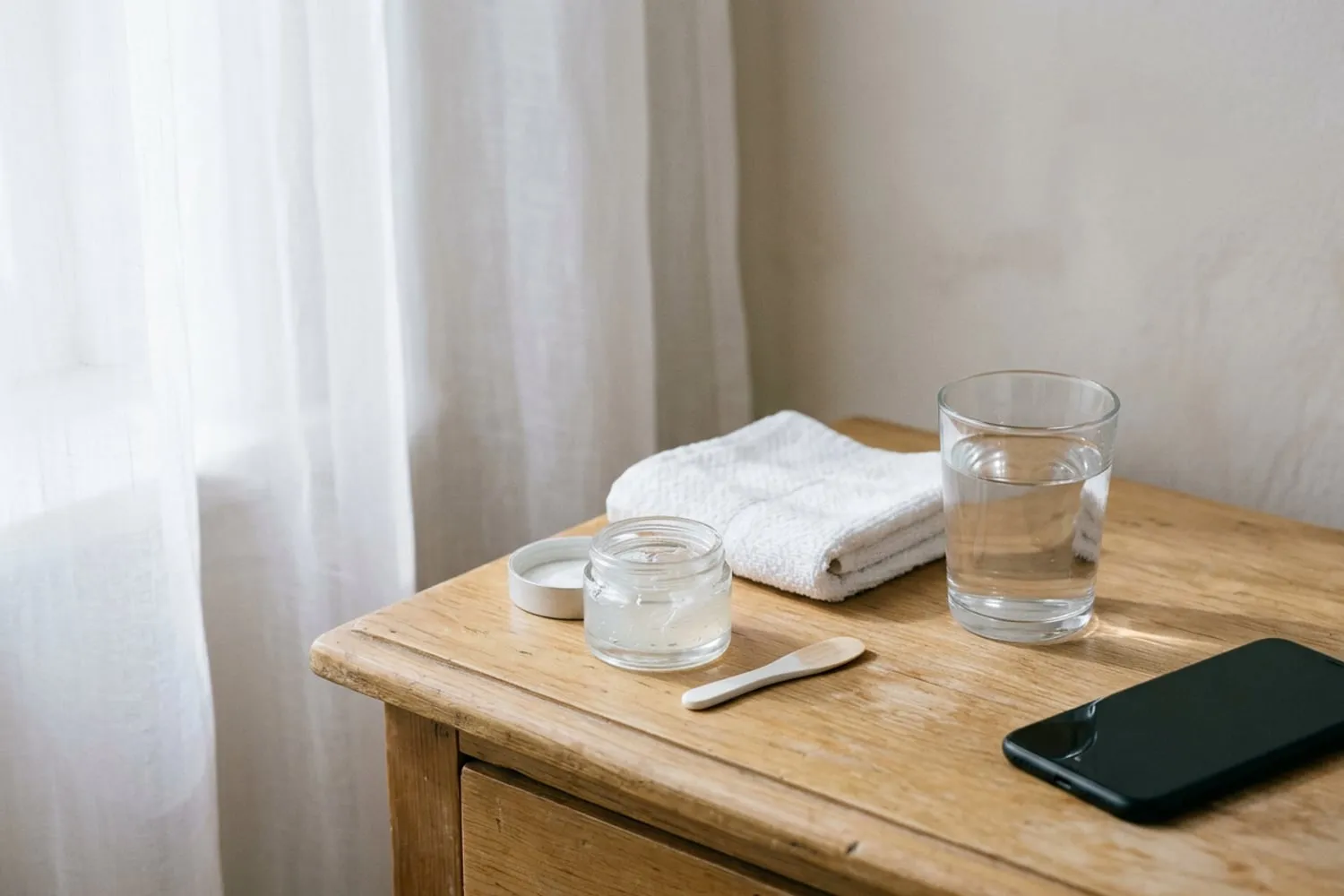
- Cleanse. Take off the day’s sunscreen and makeup with a gentle cleanser and lukewarm water, and pat dry.
- Moisturize. Use your usual moisturizer or a richer cream. A sleeping mask can go on last, over the rest, on nights when your skin feels dry.
- Keep the room cool, quiet and dark, and keep the bed for sleep.
Through the day, the AASM’s list also includes regular exercise, no caffeine in the afternoon or evening, no alcohol or large meals close to bedtime, and less to drink before bed, which may also help with morning puffiness.
Tip: if you don’t fall asleep within about 20 minutes, the AASM suggests getting up and doing something quiet in low light, away from screens, until you feel sleepy.
Our Night Veil, the sleeping mask we are developing, belongs in step 4. It is a cosmetic: it can leave your skin soft and comfortable in the morning, and it will not help you sleep. More on sleep, stress and skin is in the Wellness section.
When to talk to a doctor
Skincare cannot fix a sleep problem, and a sleep problem is worth taking seriously for far more than your skin. Talk to your doctor if:
- you have trouble falling or staying asleep most nights, and better habits have not helped;
- you sleep the recommended hours but still wake unrefreshed or feel sleepy through the day;
- someone tells you that you snore loudly or seem to stop breathing in your sleep.
For long-term insomnia, the AASM describes cognitive behavioral therapy for insomnia as the most effective long-term treatment, and a doctor or an accredited sleep center can refer you. For your skin, dark circles under one eye, swelling that does not settle, or a rash or dryness that does not improve, see a board-certified dermatologist.
Questions
Does lack of sleep cause wrinkles?
Not that any study has shown. In one 2013 study, strangers rated faces as having more fine lines after 31 hours awake, and a small 2015 study funded by Estée Lauder found more signs of skin aging in poor sleepers, but neither shows cause. The sun remains the main cause of premature skin aging, which is why daily sunscreen does more for wrinkles than any night routine.
Why do I get dark circles when I’m tired?
Tiredness can make the skin under your eyes look paler, so the blood vessels and shadows beneath show more. Dark circles also come from genetics, thinning skin with age, allergies and dermatitis, rubbing your eyes and sun exposure, so sleep alone may not clear them. A cool compress and concealer help in the short term.
Does sleeping on my side affect my face?
Pressing your face into a pillow can leave creases that are there in the morning and fade during the day. A 2016 review in Aesthetic Surgery Journal argued that years of the same pressure may set them deeper, though that rests on mechanics rather than a trial. Sleeping on your back avoids the pressure, but do not trade good sleep for it.
Can a skincare product help me sleep?
No. A cleanser, night cream or sleeping mask is a cosmetic: it can leave your skin feeling soft and comfortable, and it does nothing for your sleep. What can help is the routine itself, done at the same time each night as part of winding down.
Sources
- Beauty sleep: experimental study on the perceived health and attractiveness of sleep deprived people, BMJ (Axelsson et al., 2010)
- Cues of fatigue: effects of sleep deprivation on facial appearance, Sleep (Sundelin et al., 2013)
- Does poor sleep quality affect skin ageing?, Clinical and Experimental Dermatology (Oyetakin-White et al., 2015)
- The effect of sleep deprivation on objective and subjective measures of facial appearance, Journal of Sleep Research (Holding et al., 2019)
- Sleep Wrinkles: Facial Aging and Facial Distortion During Sleep, Aesthetic Surgery Journal (Anson et al., 2016)
- About sleep, Centers for Disease Control and Prevention