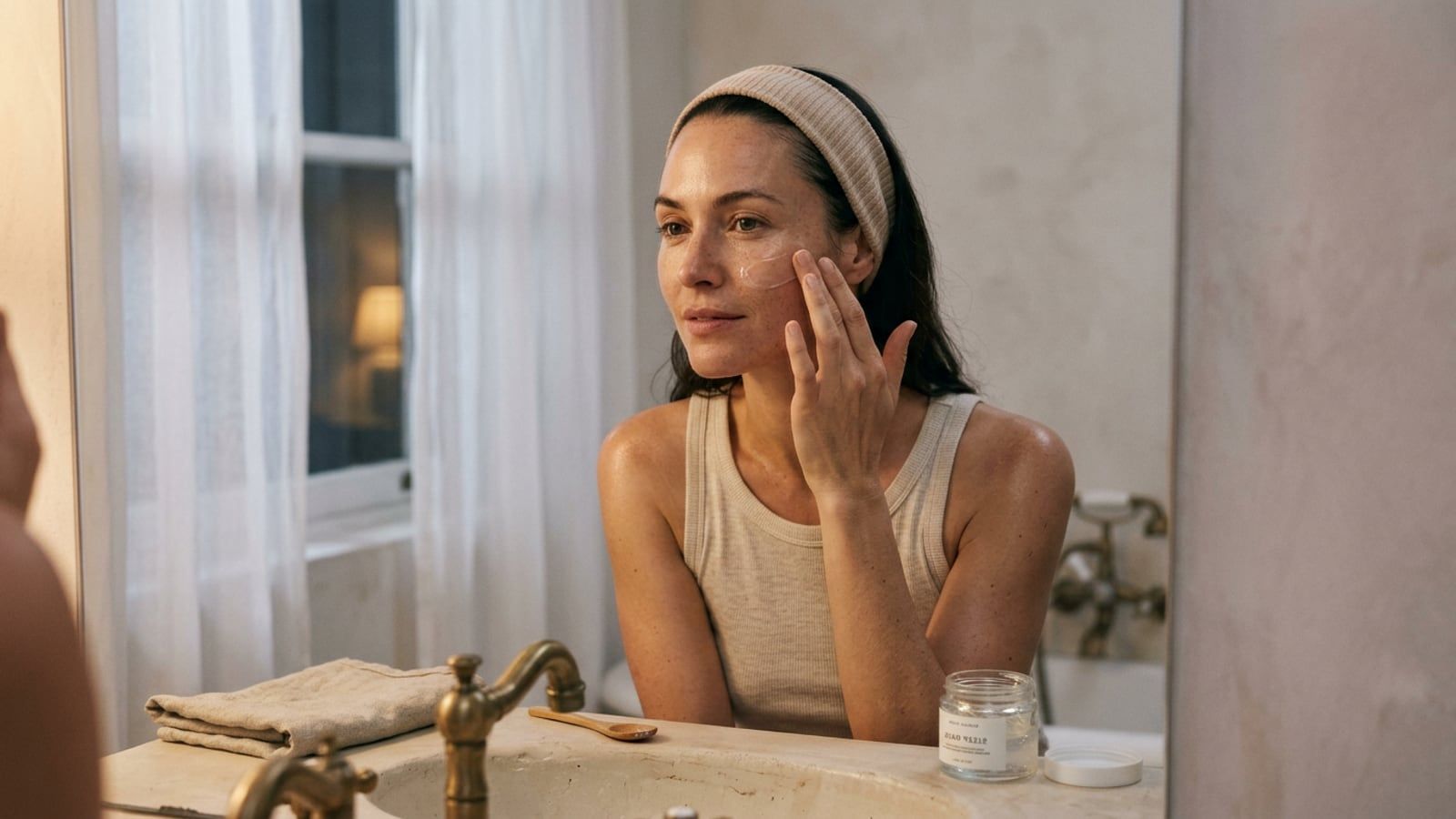
How to use a sleeping mask in your night routine
Where a sleeping mask goes at night, how much to use, how often by formula, how it differs from a night cream, and the rules for masks with acids or retinol.

A sleeping mask goes on last, in a thin, even layer.
A sleeping mask goes on last at night. Cleanse, put on whatever else you use, then smooth a thin, even layer of the mask over your face, avoiding your eyes and lips, and leave it on until morning, when you rinse it off. How often depends on the formula: a plain hydrating mask can go on as often as its label allows, while one with acids or retinol follows its directions and never shares a night with your other exfoliants. Here is where it fits, how it differs from a night cream, and what it can and cannot do.
What a sleeping mask is (and isn’t)
This is about the skincare kind: a leave-on face mask, sometimes sold as an overnight mask, a sleeping pack or a night treatment. It is usually a gel or a light gel cream that sits on top of the rest of your night routine while you sleep. It is not an eye mask that blocks out light, and it will not help you fall asleep; if your sleep is what worries you, our piece on whether sleep affects your skin covers what the research shows and when to talk to a doctor.
Most sleeping masks fall into two groups:
- Hydrating masks: humectants such as glycerin or hyaluronic acid in a gel or gel cream, made to keep skin soft and comfortable overnight.
- Masks with actives: the same kind of texture with exfoliating acids, retinol or another active ingredient in it, which changes how often you can use it and what else goes on that night.
The American Academy of Dermatology (AAD) is clear about the limits. Its guide to facial masks says a mask can help moisturize and support the skin barrier, but it is not a replacement for your skin care routine, and it does not treat conditions such as acne or eczema. If your skin is giving you real trouble, a board-certified dermatologist is the person to see.
Sleeping mask or night cream?
Both go on at night and both moisturize, so the difference is mostly in texture and in how each is meant to be used. Read the label of the one you have: it decides.
| Sleeping mask | Night cream | |
|---|---|---|
| Texture | Usually a gel or light gel cream | Usually a lotion or cream, richer than a day moisturizer |
| Where it goes | Last, over the rest of the routine | Last, or under a mask if you use one |
| How often | By the label: nightly for some, a few nights a week for masks with actives | Every night |
| In the morning | Rinse or cleanse it off | Cleanse as usual |
| Replaces moisturizer? | Some do on the nights you use them, some go over it | It is the moisturizer |
Makers differ here. Laneige’s directions for its Water Sleeping Mask put it on after face cream and say it can be used daily. Glow Recipe says its Watermelon Glow AHA Night Treatment, which contains exfoliating acids, can replace your night cream on the nights you use it, two or three times a week. Neither is wrong; they are different products with different jobs.
If you have only one routine and no mask yet, you do not need one. A moisturizer that suits your skin type does the everyday job, and our guide to building a skincare routine for your skin type helps you choose it. A sleeping mask is an extra, for nights your skin feels dry or tight, or for the texture you enjoy wearing to bed.
Step by step: where it goes at night
The Cleveland Clinic’s rule for any routine is lightest to heaviest, or thinnest to thickest. A sleeping mask is the top layer:
- Hold your hair back with a soft headband so the mask stays off your hairline.
- Take off your makeup and sunscreen, then wash your face with a gentle cleanser and pat it dry.
- Put on anything thin you use at night, such as a serum or a treatment, and give it a minute to settle.
- Put on your moisturizer, unless your mask’s directions say it replaces it.
- Smooth on a thin, even layer of the mask, about as much as you would use of a moisturizer. Keep it away from your eyes and lips unless the label says otherwise.
- Give it a few minutes to sink in before you lie down.
- In the morning, rinse or cleanse your face, then go on with your usual morning routine, sunscreen last.
The headband, and reusable pads for taking off makeup with water, are on our Kit page with the other small tools for the sink.
Before any new mask goes on your whole face, test it. The AAD suggests trying a new mask on a small area of skin first, and our routine guide sets out its method: a dab on your inner arm, twice a day for seven to 10 days. If your face itches, burns or stings once the mask is on, wash it off straight away.
How often, by formula
The label is the rule. As a starting point:
- Plain hydrating masks: as often as the directions allow, which for some is every night. Start with two or three nights a week and add more if your skin stays comfortable.
- Masks with exfoliating acids (AHAs such as glycolic or lactic acid, or BHAs such as salicylic acid): usually a few nights a week. If your skin is sensitive, start with one night a week and let it be the only exfoliant you use that day.
- Masks with retinol: start slowly, every other night or less, and build up only if your skin tolerates it.
The AAD warns that using any mask too often can irritate skin, and that adding a mask with the same active ingredients as the rest of your routine may cause dryness and irritation. If you already use an acid toner or a retinol serum, choose a plain hydrating mask, or use the active mask on other nights.
Tip: put a note on your calendar for the nights you use a mask with actives. When your skin objects, you can see what went on the night before.
Masks with acids or retinoids
An overnight mask with acids or retinol stays on your skin for hours, so treat it with the same care as any other exfoliant or retinoid.
- Not on the same night as other exfoliants or a retinoid. The AAD’s guide to exfoliating safely warns that exfoliating while you use a prescription retinoid, retinol or benzoyl peroxide may worsen dry skin or even cause breakouts. Alternate nights instead.
- Not on broken, sunburned or irritated skin. Wait until it has healed.
- Sunscreen every morning. Acids and retinoids can make skin more sensitive to the sun. Glow Recipe tells you to wear sunscreen and limit sun exposure while you use its AHA mask and for a week afterward.
- Go gently with darker skin tones. The AAD notes that irritation can leave dark marks on darker skin, so start slowly and stop if your skin turns red or stings.
- Pregnant? The AAD says retinoids should not be used during pregnancy. Ask your doctor about any mask with retinol in it.
With a prescription retinoid or a skin condition, ask your dermatologist before adding a mask with actives at all.
Pillowcases, hair and the morning after
A thin layer is the whole trick to keeping the mask on your face and off your pillowcase. Too much never sinks in, and the extra ends up on the cotton. Give it a few minutes before you lie down, keep your hair tied back or held off your face, and wash your pillowcase often.
In the morning your skin should feel soft and comfortable, nothing more dramatic than that. Rinse, then put on your usual morning routine with sunscreen last. If your skin feels greasy, use less; if it feels tight or looks red, use the mask less often or switch to a plain hydrating one.
Night Veil, the sleeping mask we are making for The Veils, is a light gel cream meant for exactly this last step. Like any sleeping mask, it is a cosmetic: it softens skin overnight, and it does not treat a skin condition or help you sleep. For more on night routines, ingredients and sunscreen, browse the Skincare section.
Questions
Do I use a sleeping mask instead of moisturizer?
It depends on the mask, so read its directions. Some are made to go over your moisturizer as a final layer, while others are rich enough to replace your night cream on the nights you use them. If your skin feels tight in the morning after skipping moisturizer, put it back underneath.
Can I use a sleeping mask every night?
A plain hydrating mask often can, if its label says so and your skin stays comfortable. A mask with exfoliating acids or retinol is usually meant for a few nights a week, so follow its directions and start at the low end. Redness, stinging or flaking mean you are using it too often.
Do I wash off a sleeping mask in the morning?
Yes. The makers of the best-known sleeping masks tell you to rinse or cleanse in the morning, then carry on with your usual morning routine. That clears what is left on your skin before sunscreen goes on.
Can I use a sleeping mask with retinol?
Not one with exfoliating acids on the same night, since the American Academy of Dermatology warns that exfoliating while you use retinol can dry skin further or even cause breakouts. A plain hydrating mask with no acids or retinoid can go over your retinol if its label allows it. With a prescription retinoid, ask the dermatologist who prescribed it.
Sources
- Do facial masks work, and should I add one to my skin care routine?, American Academy of Dermatology
- How to safely exfoliate at home, American Academy of Dermatology
- Retinoid or retinol?, American Academy of Dermatology
- How To Order Your Skin Care Routine, Cleveland Clinic