Lymphatic Drainage Face Massage: A Complete Guide
Facial lymphatic drainage may ease morning puffiness. See how to massage safely at home, choose useful tools, and know when to skip it entirely.

Think about waking up after a late night with a puffy face and heavy eyes.
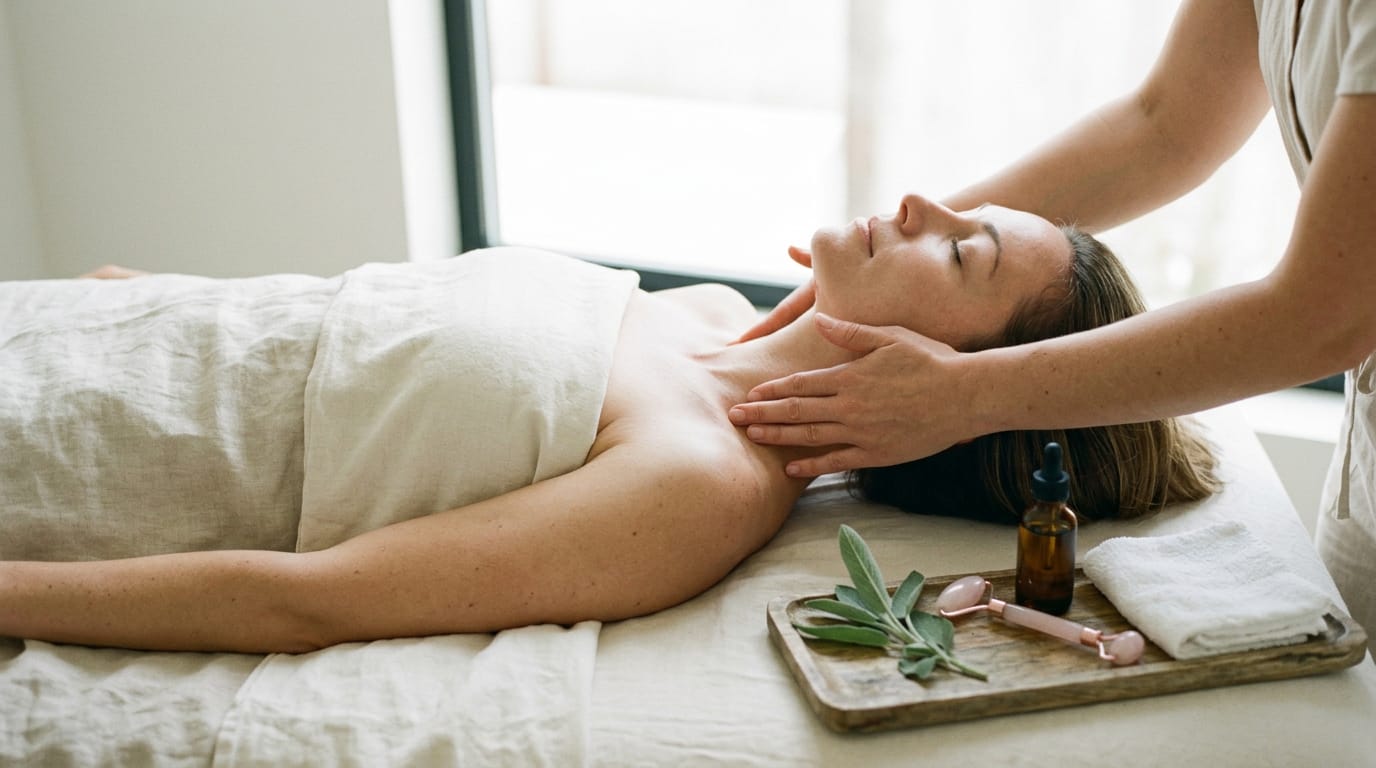
Facial lymphatic drainage is a gentle massage style aimed at that kind of puffiness, using light, sweeping strokes to encourage fluid to move along your face’s natural drainage paths.
It’s a simple add-on, not a fix for everything, so let’s look at what it is, what it can and can’t do, and how to build a safe routine you’ll actually keep. We’ll also cover which tools are worth a look and when to skip it altogether.
How Lymphatic Drainage Face Massage Works
Here’s what it does, why fluid collects in your face, and what research backs up.
Gentle light pressure that drains excess fluid
Facial lymphatic drainage uses a gentle, light-pressure massage to move excess fluid along. It’s popular among estheticians, and certified methods like Vodder are one formal way it’s taught.
Picture a bride who wakes up puffy-eyed on her wedding morning. Five minutes of gentle strokes while her coffee brews gives her a calm start and a clear sense of what it can and can’t do.
Why does my face hold lymphatic fluid?
Your lymphatic system is a network of organs, vessels, nodes, and tissues, and it’s part of your immune system. It handles fluid balance and waste removal, but it has no pump of its own. It relies on muscle movement to keep fluid moving.
Your muscles are the pump. When you’re still for long stretches, fluid can settle in your face.
What research says so far
Manual lymphatic drainage is used medically for lymphedema, a swelling condition. According to Mayo Clinic, treatment may include a special massage that helps push fluid out of the swollen area.
Research has also looked at whether manual lymphatic drainage can reduce swelling after an injury, including a rehabilitation article from proLékaře.cz on surgery for a damaged anterior cruciate ligament.
A 2015 study looked at sagging skin, but one study can’t settle the question. CNA Lifestyle notes there’s little research backing the idea that it improves skin health or appearance.
So the question is less about whether it works and more about what the evidence shows. Expect a light ritual, not a miracle.
What Facial Lymphatic Drainage Can Do
Facial lymphatic drainage is a light massage that moves lymph fluid through the face and neck. Most of its effects are temporary, so here’s where it fits and where it doesn’t.
Taming puffiness and swelling in the face
Morning puffiness is the easiest win. Picture a bride waking up for her final dress fitting with puffy eyes after salty takeout. A few minutes of light massage means she starts makeup on a face that still looks like her own.
Undereye bags and dark circles may look lighter for a while. Sinus congestion and allergies add pressure that gentle work may ease, though it’s a comfort step, not a treatment. If you’re recovering from surgery, ask your surgeon before trying it.
Puffiness often traces back to salt, sleep, or allergies. There’s no home test, but puffiness that lingers past midday is a sign drainage may be worth a try. If swelling is painful, new, or one-sided, see a doctor first.
Plenty of people hope drainage will slim their face. It can ease water-related puffiness, so your jaw looks less full for a while, but it won’t reshape bone or burn fat. Think less puffy this morning, not a permanently slimmer face.
Brighter skin and better product absorption
Facial massage may temporarily boost local blood flow, which can contribute to a brighter-looking complexion. In one roller-massage study, Miyaji and colleagues found that five minutes of roller massage increased skin blood flow for at least 10 minutes.
Drainage won’t add moisture, so dryness still calls for the moisturizer you already trust.
Facial lymphatic drainage is promoted as a way to soften the look of fine lines and wrinkles. A literature review on lymphatic massage and skin aging links facial massage to collagen and elastin production, which it ties to the smoothing of wrinkles.
Many people hope their serum sinks in better afterward, so test it on your own skin.
Fewer breakouts and clearer pores
Some TikTok creators say drainage clears breakouts. CNA Lifestyle reports those claims, so treat them as something to test, not a guarantee.
Clearing pore congestion is still a cleanser-and-treatment job, with drainage as a relaxing bonus. The forehead pitch is that moving fluid keeps the brow from looking stagnant.
Easing tension, stress, and built-up waste
Lymphatic drainage is often described as helping remove toxins and waste. In plain terms, Jackson Health says the massage is designed to encourage lymph fluid to move through the body’s lymphatic system, a narrower job than full waste removal.
Ten slow minutes can make a packed week feel lighter. Slow strokes along your cheeks and temples can also release the tension in a jaw you’ve been clenching through wedding planning.
For plenty of readers, the ritual is the point: a few quiet minutes with a face oil before bed.
Less benefit if you’re already healthy
If you’re generally healthy, expect more relaxation than results. Soyeon Jo, a certified lymphedema therapist at STARS Rehabilitation, Northwell Health says people with healthy lymphatic systems may enjoy relaxation without seeing much change.
Relaxing, yes. Health-boosting, not so much.
Doing Facial Lymphatic Drainage at Home
Here’s how to fit facial lymphatic drainage into your routine without adding more products.
How often and when to do it
Think of a bride who does this while her hair is setting. Five minutes later she’s done, and her wedding morning has one less thing to fuss over.
Nightly or a few times a week works, so pick the rhythm you’ll actually keep. Morning or evening both work. Keep each session under ten minutes and do it right after your serum step. Consistency beats intensity here.
Prep your skin and choose your products
Here’s the order:
- Wash your hands and cleanse your face.
- Apply your serum.
- Add a thin layer of face oil or moisturizer for slip, the glide that keeps your fingers from dragging. At night, a light night-routine oil works well. Prefer to skip oil? A sheet mask is an option too.
- Wipe away any excess and finish with your moisturizer.
Follow the routine from neck to forehead
Start at your neck and work upward, always draining toward the neck and its lymph nodes.
- Neck: Sweep gently down toward your collarbone.
- Jawline and chin: Glide from your chin along your jaw, then down to your neck.
- Under-eye and orbital area: Use the lightest touch of the whole routine here, as covered below.
- Cheeks and sides of face: Sweep outward, then down toward your neck.
- Forehead and temples: Move from the center of your forehead out to your temples, then down.
To massage eye bags, use your lightest touch. Start at the inner corner of your eye, glide along the bony rim around your eye, then sweep toward your temple and down toward your neck.
Don’t tug at the skin, since it’s delicate and the tiny vessels crush easily.
Use very light pressure with J-shaped strokes
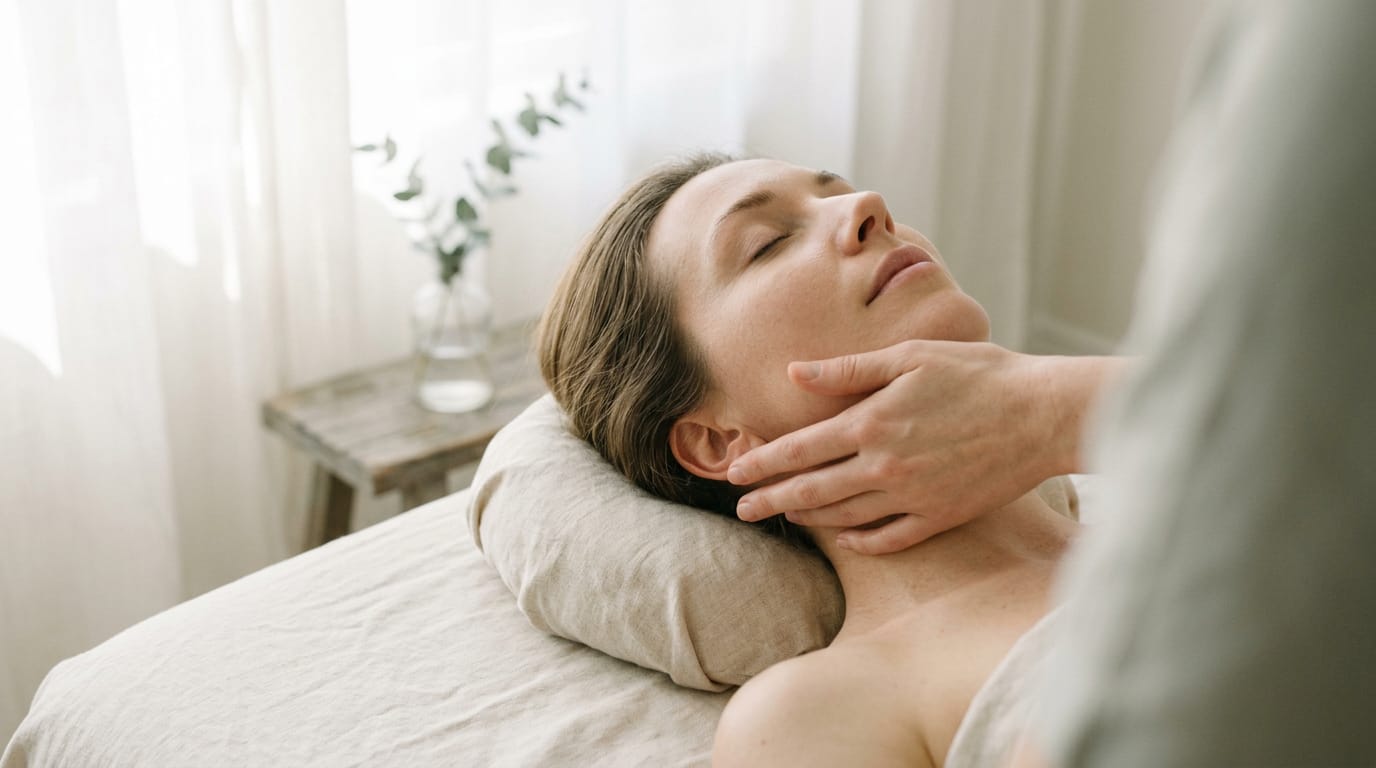
Keep your touch light, because this is the part to get right. Here’s what that looks like:
- Very light pressure: Think light rather than firm.
- J-shaped or circular strokes: Trace a J or a small circle with each pass.
- Delicate vessels crush easily: Firm pressure is the one thing to skip.
- Repeat three times: Run each stroke three times before you move on.
Consider a new mom with three minutes before her baby wakes. She repeats each stroke, keeps her touch light, and finishes without rushing. Lighter is better.
Which Tools and Devices Are Worth It
Plenty of tools promise a glow-up, but few earn a spot on your counter. Here’s what’s worth keeping and what you can skip.
Hands beat most tools, except gua sha
Your hands are the best tool most of us already own. They’re warm, free, and let you feel how much pressure your skin can take that day. Think of a bride with a puffy face on her wedding morning and ten minutes to spare.
A few drops of facial oil and a slow sweep from her cheeks toward her ears beats unpacking a gadget she’d have to charge first.
The exception is gua sha, a smooth, flat tool that glides across the skin. If you buy just one tool, make it this one. It’s less about the stone itself and more about the control it gives you, a steady stroke that’s harder to hold with fingertips alone.
Jade rollers get a lot of criticism, and much of it is fair. The cool stone feels lovely, but it doesn’t do much more than your hands can. Keep one if you love the ritual.
As for how often to use it, start with a few minutes a few times a week and watch how your skin responds. If it looks red or feels tight, ease off. More isn’t better.
A vibrating roller or sculpting bar adds a buzz some people enjoy. If it’s one more thing to charge and clean, it’s easy to leave out.
The face roller is the one to reach for when you want to try lymphatic drainage. Roll slowly with light pressure, starting at the center of your face and working outward and down toward your collarbone.
Do each side two or three times, then finish with a gentle sweep under the jaw. Keep it to a few minutes, and skip the delicate eye area if your skin is sensitive.
Safety Checks and When to Skip It
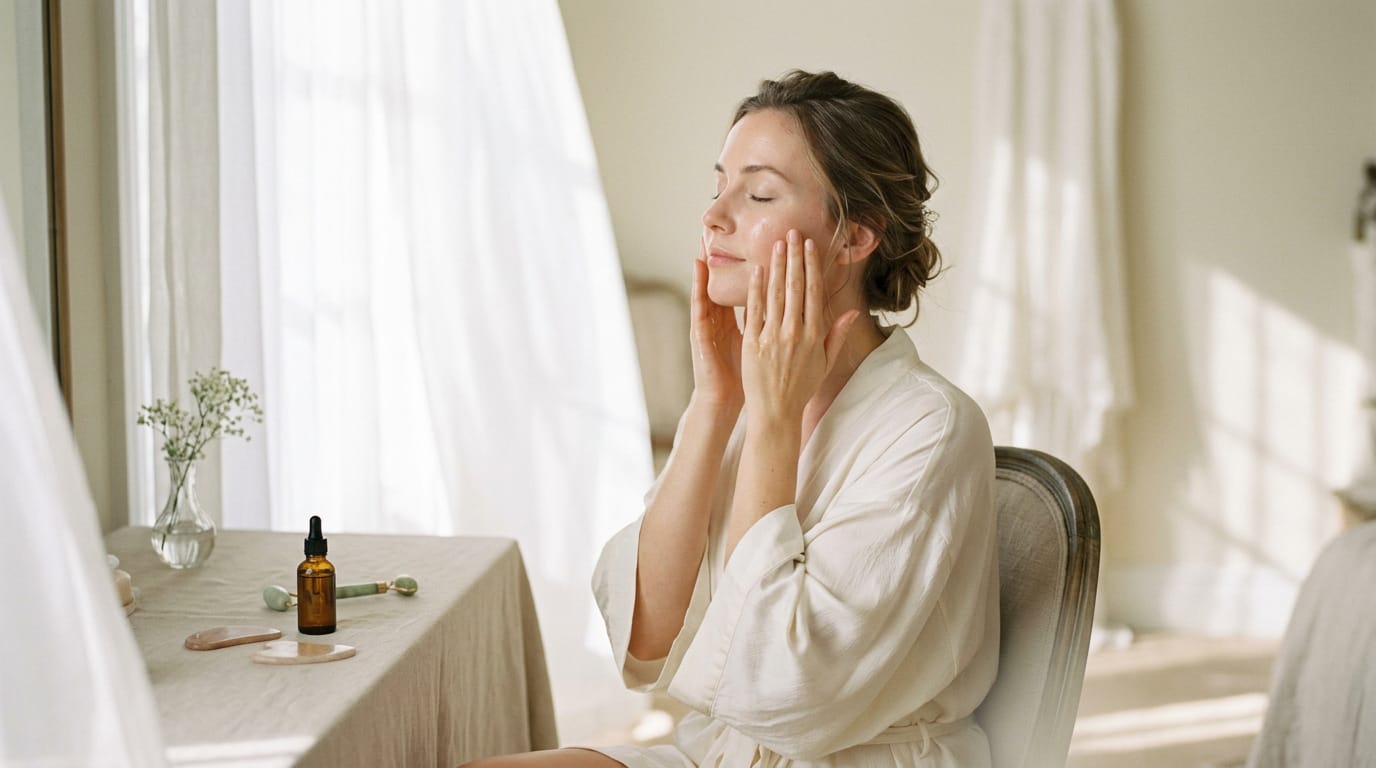
Facial lymphatic drainage is gentle, but gentle isn’t the same as always safe for everyone. Before you start, run through these checks so you know when to skip the routine and when to get a professional’s go-ahead.
Skip massage if any of these apply
If any of these describe you right now, hold off on the massage:
- Active inflamed acne
- Open sores or cuts
- Blood clots
- Heart failure or heart problems
- Kidney problems
- Infection
- Recent sunburn or scars
Each item on that list is a reason to wait, not a reason to panic. Think of a bride with a sunburn on her cheeks a few days before the wedding.
She skips her drainage session that week, keeps to a gentle cleanser and moisturizer, and walks down the aisle with calm skin. When in doubt, skip it.
Ask your doctor and watch for reactions
Talk to your doctor first, even if you feel healthy, and especially if anything above applies to you. After a session, pay attention to how your body responds. If you notice any of these, stop and check in with your doctor:
- Headaches
- Nausea
- Fatigue
Watch for lymphedema, which is swelling caused when lymph fluid doesn’t drain well. Look for swelling or tightness that is new or doesn’t go down.
Finally, check for progress. Jot down how your skin and any swelling look each week, so you can share real changes with your doctor over time, not just one good or bad morning.
How Doctors and Therapists Use It
Doctors and therapists use lymphatic drainage for several specific conditions and in several named styles.
Conditions treated, from lymphedema to lipedema
It’s used, or discussed, for several conditions, starting with lymphedema, swelling that builds when lymph fluid can’t flow freely:
- After cancer surgery. Mayo Clinic notes that removing lymph nodes during cancer surgery can disrupt fluid flow, and lymphedema can follow.
- Rheumatoid arthritis. A 2019 review on lymphatic function in autoimmune diseases covers rheumatoid arthritis and asks whether massage could improve lymphatic function.
- Chronic venous insufficiency and fibromyalgia. A PhillyVoice piece says people with either may benefit, though research suggests the benefits may be limited.
- Lipedema. Lipedema.net calls lymphatic massage an important part of treatment.
- Combined with compression and exercise. A review in Current Physical Medicine and Rehabilitation Reports says treatment may pair manual lymphatic drainage with compression, therapeutic exercise, and skin care.
Named styles like Vodder, Foldi, and Leduc
Lymphatic drainage isn’t one fixed method. You’ll hear named styles like Vodder, Foldi, Casley-Smith, and Leduc, so ask your therapist which one they use. Sessions last 15 to 60 minutes, which is short enough to fit between work and a dress fitting.
Picking a certified therapist with lymphedema training
Look for a certified therapist with lymphedema training, and ask how many lymphedema training hours they’ve completed.
Consider a bride who had lymph nodes removed during cancer treatment: she checks with her doctor, then books sessions around her dress fittings so the wedding week stays calm.
Professional facial sessions are another route if you’d rather not do it yourself. Either way, lymphatic drainage works alongside your other care, not instead of it.
Ask your doctor first.
Facial lymphatic drainage works best as one gentle step in a routine, not a cure. Keep your strokes light and your timing consistent, and you’ll get more from a few calm minutes than from any gadget on your shelf.
Know what it can and can’t do, skip it when your skin or health calls for caution, and keep it simple enough to reach for on a busy morning.
Your best routine is the one that feels easy enough to repeat tomorrow.
References
- The Effect of Mechanotherapy on Swelling after LCA… — prolekare.cz (2026)
- The effect of lymphatic massage and physical activity on delaying signs of skin aging: A literature review — doi.org (2025)
- Comparative Effects of Facial Roller and Gua Sha Massage on Facial Contour, Muscle Tone, and Skin Elasticity: Randomized Controlled Trial — pmc.ncbi.nlm.nih.gov (2025)
- Does Lymphatic Drainage Massage Actually Work? — thewell.northwell.edu (2026)
- International Strategies for Lymphedema Management | Current Physical Medicine and Rehabilitation Reports — link.springer.com (2025)
- Manual lymphatic drainage treatment for lymphedema: a systematic review of the literature — pubmed.ncbi.nlm.nih.gov (2020)
- Does lymphatic drainage massage make your skin healthier? — cnalifestyle.channelnewsasia.com (2026)
- Manual Lymphatic Drainage: Effects, Use & Human Studies — ih-research.com (2026)
- Does lymphatic drainage work? Research suggests its benefits may be limited — phillyvoice.com (2026)
- Lymphedema - Symptoms and causes — mayoclinic.org
- Understanding Lymphatic Drainage: A Massage Not Meant for Muscles — jacksonhealth.org
- » Massage & Lymphatic Drainage Benefits — lipedema.net
Questions
What is the best drink for lymphatic drainage?
There is no proven drink that specifically improves lymphatic drainage. Staying hydrated with water supports normal fluid balance, but facial puffiness may also relate to salt, sleep, or allergies.
What is a manual lymphatic drainage massage for the face?
Manual lymphatic drainage for the face is a gentle massage using very light, sweeping strokes to encourage lymph fluid to move along the face’s natural drainage paths toward the neck. It may temporarily ease fluid-related puffiness, but it does not reshape the face or replace medical care.
What is the best face roller for reducing wrinkles?
No face roller is proven to reduce wrinkles permanently. A roller can provide a relaxing massage and may temporarily increase local blood flow, but hands work well for drainage; choose a smooth tool you can use gently and comfortably.
How to massage eye bags?
Use the lightest touch around the eyes. Starting at the inner corner, glide along the bony rim toward the temple, then sweep down toward the neck; avoid tugging or pressing on the eyelid.
How to slim face lymphatic drainage?
Use gentle strokes to ease fluid-related puffiness, not to remove facial fat or change bone structure. Sweep from the chin along the jaw toward the ears, then down the neck; move outward across the cheeks and forehead, finishing toward the neck. Results, if any, are temporary.
How to do lymphatic drainage with a roller?
Apply a thin layer of oil or moisturizer so the roller glides without pulling. With very light pressure, roll slowly from the center of the face outward and down toward the collarbone, repeating each side two or three times; avoid the eye area if your skin is sensitive.
How often should you use a jade roller?
Start with a few minutes a few times a week and see how your skin responds. If it becomes red or feels tight, use the roller less often or stop; more pressure or longer sessions are not better.
Why do I have lymphatic fluid in my face?
Lymph fluid is normally present in facial tissues as part of the body’s fluid-balance and immune systems. It can collect and make the face look puffy, for example after long periods of stillness or with factors such as salt, poor sleep, or allergies. New, painful, one-sided, or persistent swelling should be checked by a doctor.
Sources
- Lymphedema - Symptoms and causes - Mayo Clinic, mayoclinic.org
- The Effect of Mechanotherapy on Swelling after LCA... | proLékaře.cz, prolekare.cz,
- Manual lymphatic drainage treatment for lymphedema: a systematic review of the literature - PubMed, pubmed.ncbi.nlm.nih.gov,
- Does lymphatic drainage massage make your skin healthier? - CNA Lifestyle, cnalifestyle.channelnewsasia.com,
- The effect of lymphatic massage and physical activity on delaying signs of skin aging: A literature review, doi.org,
- Comparative Effects of Facial Roller and Gua Sha Massage on Facial Contour, Muscle Tone, and Skin Elasticity: Randomized Controlled Trial - PMC, pmc.ncbi.nlm.nih.gov,
- Understanding Lymphatic Drainage: A Massage Not Meant for Muscles, jacksonhealth.org
- Does Lymphatic Drainage Massage Actually Work? | The Well by Northwell, thewell.northwell.edu,
- Manual Lymphatic Drainage: Effects, Use & Human Studies, ih-research.com,
- Does lymphatic drainage work? Research suggests its benefits may be limited | PhillyVoice, phillyvoice.com,
- » Massage & Lymphatic Drainage Benefits - Lipedema, lipedema.net
- International Strategies for Lymphedema Management | Current Physical Medicine and Rehabilitation Reports | Springer Nature Link, link.springer.com,