How to use hair oil: damp or dry, and how much
When to put hair oil on, damp, dry or before washing, how many drops for fine, wavy, curly and coily hair, and how to keep it off your roots.

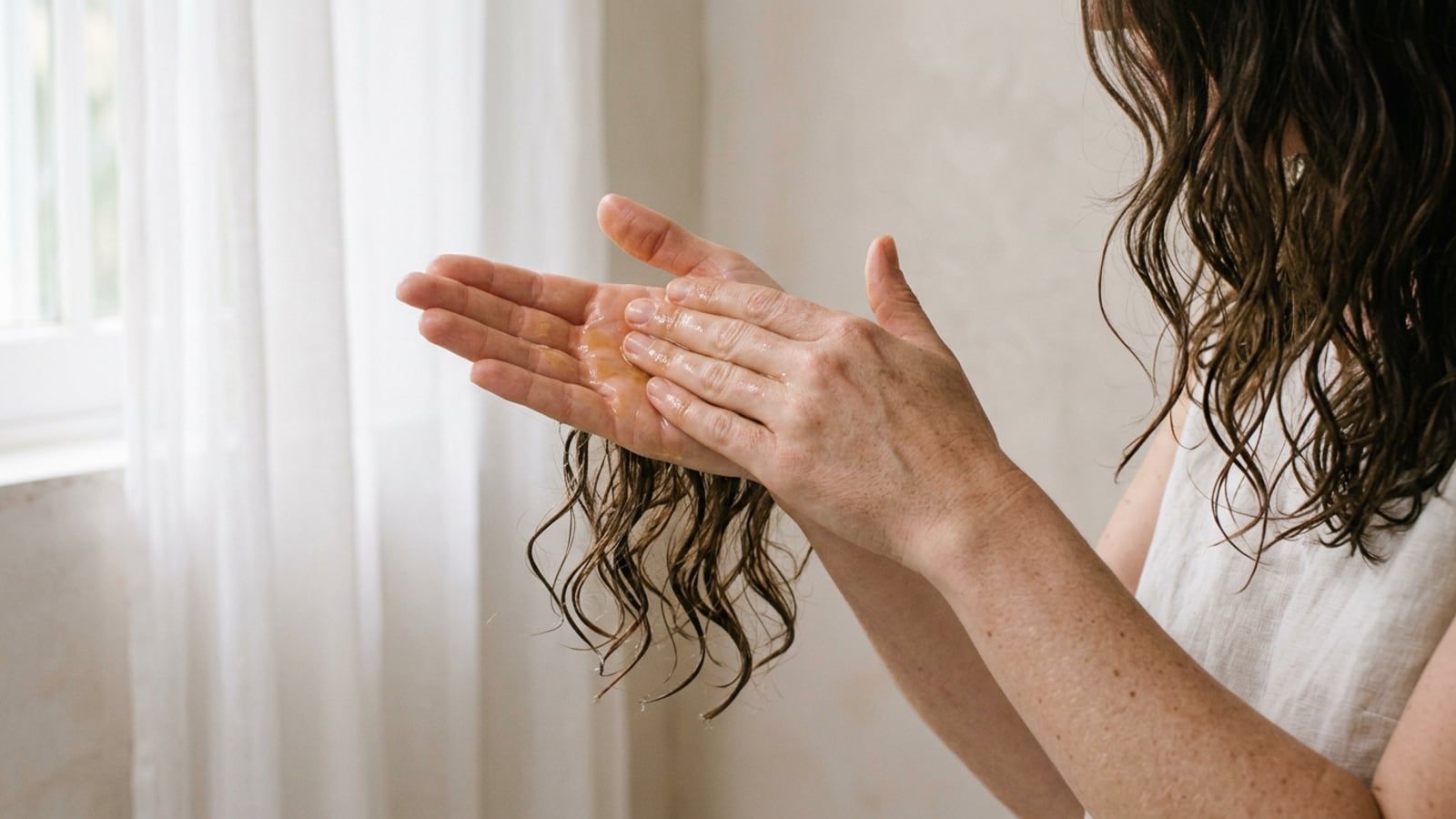
Warm the oil between your palms first, then smooth it over the lengths and ends.
Put hair oil on the lengths and ends, never the roots, and start with less than you think: one or two drops for fine hair, a few more for curls and coils. Warm the drops between your palms, then smooth them down over damp hair to hold the moisture in, or over dry hair to tame frizz and add shine. Add another drop only if your ends still feel dry. The rest of this guide covers which of those to choose, how much suits your texture and when oil is not the right tool at all.
Damp hair or dry hair?
Choose by what you want the oil to do. Both are right; they do different jobs.
- Damp hair, to seal in moisture. After washing and conditioning, squeeze the water out with a towel, put on your leave-in conditioner if you use one, then add oil over it. The oil sits on top and slows the water leaving the hair. It also gives the strands slip, so a comb or detangler moves through with less pulling.
- Dry hair, to finish. A drop or two smoothed over the surface of dry hair lays down flyaways, softens frizz and adds shine. This is also the way to refresh ends that look dry between wash days.
- Before washing, to protect. Oil on dry hair for a while before you shampoo, often called a pre-poo, is covered below.
Skip dripping-wet hair: the oil slides off with the water and you end up using more. Damp, after a squeeze in the towel, is the point to aim for.
Why it helps at all: a review of hair cosmetics in the International Journal of Trichology explains that some oils, coconut oil among them, can enter the hair shaft and reduce how much water it soaks up, which limits the repeated swelling and drying that wears hair down. Others, such as mineral oil, stay on the surface as a thin film that adds gloss and cuts friction between strands. The review also notes that oil treatments reduced wet combing force and the formation of split ends in the studies it covers.
How much oil for your texture
Oil travels along straight hair easily and hardly at all along tight curls, so the amount changes with your texture. The figures below are starting points. Begin at the low end, look at your hair once it is dry, and adjust by one drop at a time.
| Texture | Start with | Where it goes | Best on |
|---|---|---|---|
| Fine or straight | 1 to 2 drops | The last few inches only | Dry hair, to finish |
| Wavy | 2 to 3 drops | Mid-lengths to ends | Damp or dry hair |
| Curly | 3 to 5 drops | Mid-lengths to ends, scrunched in | Damp hair, over a leave-in |
| Coily | 4 drops or more | Section by section, lengths and ends | Damp hair, over a leave-in |
Fine, straight hair shows oil fastest; the review notes that leave-on products on straight hair can leave it looking oily and dull. If yours goes flat by the afternoon, halve the amount or move it lower. Thick, coily hair can take more, worked through in sections so every part gets a little rather than the top getting all of it. The longer your hair, the more drops it takes to reach the ends.
Step by step
- Start with clean, towel-dried or dry hair. Wrap wet hair in a towel to soak up the water rather than rubbing it, which the American Academy of Dermatology (AAD) lists among the hair care habits that damage hair.
- Put one or two drops in your palm. Use the low end of the table for your texture.
- Rub your palms together. Warming the oil spreads it into a thin layer, so it coats instead of clumping.
- Smooth it over the ends first. Start at the bottom few inches, where hair is oldest and driest, and work up toward the mid-lengths. Stop well short of the roots.
- Comb it through. Use a wide-tooth comb or a wet detangler, such as the Tangle Teezer on our Kit page, from the ends up, so the oil reaches every strand.
- Wait before adding more. Look at your hair once it is dry. If the ends still feel rough, add a single drop with your palms.
- Finish with what is left on your hands. Pass your palms lightly over the surface to catch flyaways, and stop there.

The Hair Veil, the weightless oil we are bringing out as part of The Veils, is meant for exactly this: two or three drops warmed in the palms and smoothed over the lengths, never the roots.
Oil before washing (pre-poo)
A pre-poo is oil put on dry hair before you shampoo, to cushion the lengths through the wash. The review in the International Journal of Trichology cites a study in which coconut oil, used before and after washing, was the only oil tested that reduced protein loss from both undamaged and damaged hair.
- On dry hair, section it if it is thick or curly.
- Smooth oil over the lengths and ends. Use more than you would for styling, enough to coat the hair without dripping, and keep it off the scalp.
- Leave it on for half an hour or so, or overnight with a satin cap over your hair and a towel on your pillow.
- Shampoo the scalp, letting the lather run down the lengths as you rinse. You may need a second round of shampoo to take the oil out.
- Condition as usual, then style.
Once a week, before wash day, is plenty. If your hair feels heavy or coated after washing, use less next time or go back to oil only after washing.
Oil and heat tools
Most hair oils are not heat protectants. Unless the label says it protects hair from heat, assume it does not. Smoothing oil on before a flat iron mostly adds a slick layer for the iron to pass over, and it can leave hair looking greasy rather than polished.
For heat styling, use a product sold as a heat protectant and follow its label. The AAD’s advice on heat tools is to air dry when you can, use the lowest setting, limit how long the tool touches your hair and use heat about once a week or less. Save the oil for afterward: once your hair has cooled, a drop over the ends smooths what the heat roughed up.
Tip: on blow-dry days, put the oil on after drying, not before. A single drop on dry ends shows you exactly how much your hair wants.
When oil is not the answer
Oil makes hair look and feel smoother, and in the studies the review covers it helped prevent split ends. It cannot mend hair that is already damaged. A few cases need something else:
- Split ends you can already see. Oil makes them less visible for a day, but only a trim takes them away. Ask your stylist to take off what is split, then oil the ends to protect the new ones.
- Greasy roots and flat hair. You may be using too much, or oil is not the right finish for your hair. Try a lighter leave-in conditioner instead, or oil only the last inch.
- A dry, flaky or itchy scalp. Flaking has several causes, from dandruff to skin conditions, and each needs its own care; oil treats none of them. A dermatologist can tell you which it is.
- Thinning, shedding or bald patches. No oil treats hair loss. The AAD advises seeing a board-certified dermatologist if changing your hair care does not help, and especially if you notice thinning or hair loss, since many causes can be treated and earlier is better.
For the rest of wash day, from shampoo to styling with and without heat, the Hair section has a guide for every texture. And if you like the slip of oil on damp skin as much as on damp hair, the same habit works below the chin: our guide to exfoliating your body safely ends with oil or lotion on damp skin straight after the shower.
Questions
Should I put hair oil on wet or dry hair?
Both work, for different jobs. On damp hair, after your leave-in, oil helps hold the water in and makes detangling easier; on dry hair, a drop or two smooths frizz and flyaways and adds shine. Avoid dripping-wet hair, where the oil slides off with the water.
Can I put hair oil on my scalp?
A styling oil belongs on the lengths and ends, where hair is oldest and driest; on the scalp it mostly makes the roots look greasy sooner. If your scalp is dry, flaky or itchy, see a dermatologist before reaching for oil, since flaking has several causes that need different care.
Is hair oil a heat protectant?
Not unless the label says so. Most oils are not made or tested to protect hair from a dryer or an iron, so use a product sold as a heat protectant, keep your tools on a low setting and add oil once your hair has cooled.
How often should I oil my hair?
As often as your ends need it. Fine hair may only want a drop on styling days, while curly and coily hair often takes a little oil every day or two. If your hair starts to look limp or feel coated, use less or skip a day, and use oil before washing once a week at most.
Can I leave oil in my hair overnight?
Yes, as a pre-wash treatment on the lengths, as long as you wash it out in the morning. Cover your hair with a satin cap or a towel on your pillow, since oil marks cotton, and keep it away from your scalp if your roots get greasy quickly.
Sources
- Hair Cosmetics: An Overview, International Journal of Trichology (Gavazzoni Dias, 2015)
- 10 hair care habits that can damage your hair, American Academy of Dermatology