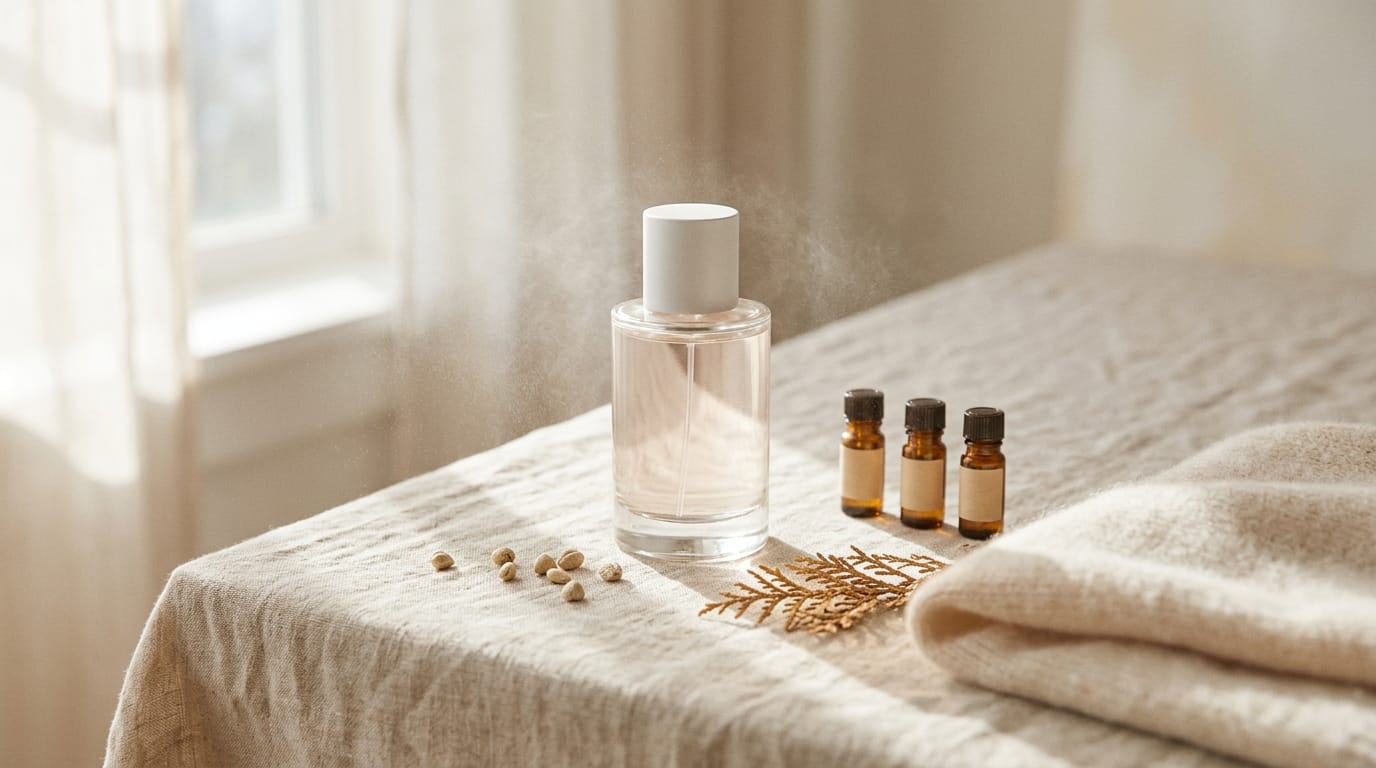
Musk Scent Explained: Types, Notes, and Best Picks
Musk scent can feel warm, clean, or skin-close. Compare its main types and see how each shapes a perfume’s lasting base, with musk fragrances to try.

Think about the hug you get from someone you love, and the warm scent that lingers on their collar hours later. That’s the feeling musk is known for.
In perfume, it’s a base note, the deep, lasting layer that makes a fragrance feel like it’s resting on your skin.
Musk comes in several forms, and each one smells a little different. In this guide, we’ll cover what it smells like, its main types, how it shapes a perfume, a few picks worth trying, and how to choose, test, and wear a musk that stays close to you.
What Musk Scent Is and Its Source
Before you shop, it helps to know what musk is and where it came from, so let’s start there.
Musk is a family, not one scent
Musk is a category of notes, not one smell, so two bottles labeled musk can smell quite different.
Musks tend to be soft, warm, and skin-like. Consider a bride who dabs one on her wrists before the ceremony. Hours later, at the reception, she still catches a warm trace when she lifts her hands.
Musk is also a paradox: it can smell clean and soapy yet carry an animalic edge, a warm, slightly wild quality. It’s a common base ingredient too. Musk is less about projecting and more about staying close to your skin.
How animals originally supplied musk
Natural musk came from animals. The male musk deer’s gland secretion was the classic source, with civets and beavers among the other animal sources. Getting it meant killing the animal, a steep price for a perfume note.
According to a Biodiversity Heritage Library entry on musk deer, illicit hunting to meet international demand, combined with habitat destruction, led to a drastic decline in musk deer populations. Restrictions on trade and hunting followed.
Today’s lab-made and plant-based options
Today’s musk options don’t have to come from animals. They come in a few forms:
- Synthetic musk, which replaces animal-derived musk.
- Musk deer-derived notes, recreated synthetically.
- Cruelty-free and vegan options, built from synthetic or plant-based ingredients.
- Ambrette, a plant alternative with a musky note and no animal ingredients.
Keep the warmth, leave out the animal.
How chemists first learned to make musk
The story starts with an accident. Albert Baur was investigating the synthesis of explosives in the 1880s when he noticed a strong musky smell. According to a Chimia account of a serendipitous discovery, that accident led to synthetic musk.
Decades later, in 1926, Leopold Ružička synthesized the key scent molecule of natural musk. A 2026 study on muscone-macrocycles notes it was the first time a macrocycle, a large ring-shaped molecule found in nature, could be made chemically.
The push was as much about supply as about ethics. Demand for natural musk was high, and harvesting harmed the deer. Both pushed chemists toward the lab.
The Many Ways Musk Smells
Musk doesn’t smell the same to everyone, and that’s part of its charm. Here’s how people describe it, and why it often feels like a second layer of skin.
Words people use to describe its smell
People reach for familiar comparisons. You’ll hear it called:
- Clean laundry, sheets, and skin: fresh, just-washed softness.
- ‘Your skin, but better’: a polished version of the scent you already carry.
- Soft, powdery, and soapy: a gentle, clean finish.
- Animalic, leathery, and earthy: deeper, grounding notes.
- Fruity, floral, or woody variations: musks blended with brighter or drier notes.
Most of these point back to skin, since musk is built to sit close to you.

Musk is not always heavy and dark
Many people picture musk as heavy and dark, but that’s only part of the story. Its history leans heavier: originally, musk was a rich, leathery scent.
Modern musks are often subtle rather than loud, and many read clean enough for the office or a rehearsal dinner. Heavy is optional.
Why people love its skin-like warmth
Most of us are drawn to clean smells, and musk delivers that without sharp edges. It also carries memory: a soft musk can bring back a favorite sweater or a clean bed from childhood.
Musk also works with your body chemistry, so it can read a little different on you than it does on a friend.
Consider a bridesmaid who dabs a soft musk on her wrists before the morning photos. By the reception she hasn’t touched it up once, and her hugs still smell like her. One bottle, one application, all day.
That warmth is what we mean by a skin-close musk: one that stays intimate and soft instead of announcing itself across the room. Choose one when you want a scent that feels like your own skin, only better.
What perfumers say about musk
Musk is a study in contradictions. It’s clean yet warm, familiar yet hard to name, soft yet hard to forget. The best musks float like a feather: they lift off the skin and never weigh down the room. Light enough to forget, present enough to notice.
The Main Kinds of Musk
Musk isn’t one smell, so we’ll sort out the main families before you buy. Here’s how each one smells, performs and where it comes from.
How white musk smells and performs
White musk is synthetic, dating to the late 19th century. In 1888, German chemist Albert Baur, working on explosives, isolated a compound with an unexpectedly strong musk-like odor, as Osmetheca’s white musk entry recounts.
It’s fresh rather than heavy: soapy and linen-like. As a fixative, it helps other notes last longer on skin, so it’s unisex and easy to layer.
Consider a bride with a wedding morning ahead. She can layer a light white musk over her moisturizer. Her perfume then smells like her, freshly showered.
Natural deer musk, banned and prized
Natural deer musk is animalic, leathery and slightly fecal. Historically it was valued like gold. Today it’s banned or restricted, so for most readers it’s more history than shopping.
Sweet cocoa and vanilla musk blends
A gourmand blend isn’t a true type of musk. It’s a sweet style that pairs musk with:
- vanilla
- cocoa
- cinnamon
It’s popular in Middle Eastern perfumery.
Synthetic musk falls into chemical groups
Synthetic musk falls into a few chemical groups:
- Nitro musks have raised concerns about hormonal effects. A study on synthetic musk ketone notes that synthetic musks can disrupt hormones, among other toxic effects.
- Polycyclic musks don’t break down easily. Safe Cosmetics reports that synthetic musks are only partially biodegradable and build up in living things.
- Macrocyclic musks are the most used today in modern perfumery, including muscone, exaltolide and ambrettolide. A 2023 historical review in the European Journal of Organic Chemistry notes that Ruzicka and colleagues synthesized several macrocyclic musks between 1924 and 1934.
Watch for similar names, too. Ambrette, ambroxan and amber often come up alongside musk, but they’re different ingredients, so check the notes list rather than assuming.

How Musk Shapes a Perfume
Musk rarely takes center stage, but it does much of the quiet work in a bottle. Here’s how we see it working on your skin.
How musk anchors the lighter notes
Perfumes unfold in layers, and musk usually lives in the bottom one. It’s a base note, the layer that lasts longest after the brighter parts fade.
Top and heart notes tend to be volatile, meaning they evaporate quickly, so musk anchors them to keep them from vanishing before you’ve left the house. It isn’t locked to the bottom, though.
Some perfumers add it higher up, so you may catch a clean hint at the first spritz.
Mixing musk to soften and deepen scents
Musk is a strong blending tool. It softens the shift from a sharp citrus or spicy accent into the heart of a scent, and it adds depth the notes alone can’t offer.
It can amplify the fragrances around it or diffuse them into a softer haze, and it lends human warmth that reads as close rather than sharp. The point is less about how far a scent travels and more about how close it stays.
If you can’t find musk, patchouli is a similar substitute, though not an exact match.
Musk in laundry, soap, and candles
Musk doesn’t stop at perfume. Laundry detergents, soaps, and lotions use musky notes for a clean, soft finish, and candles, room sprays, and personal care products follow suit.
If you blend your own, a small amount in an unscented lotion can carry the mix.
Consider a bridesmaid who hangs her dress in the closet the night before the wedding. A musk-scented drawer sachet keeps the fabric fresh, so the only scent on her that morning is the one she chose.
Why musk suits any gender or mood
Musk is genderless and mood-driven. You reach for it based on how you want to feel, which makes it a natural unisex scent. It pairs with a wide range of scents: a floral with musk reads softer and closer to skin, while a spicy one turns warm and grounded.
Take a new mom who needs something gentle for a 2am feeding and a quick grocery run. A light musk with a hint of floral gives her a put-together finish without announcing her arrival before she does. Musk adapts to your day.
Best Musk Fragrances to Try
Choosing your musk starts with strength, format, and how close to skin you want it. Here’s where our editors land, and what we’d test first.
What our editors rank highest
Phlur Missing Person is our editors’ top pick overall. Floral, clean, gourmand, and woody picks cover a range of moods, while powdery, citrus, and layerable picks suit blending. Check current prices and tester feedback before you commit.
Sample on skin before buying, since a scent wears differently on you than on paper.

Brands that build collections around musk
Boadicea has fragrances featuring musk, and Snif Me, Way With Woods, and Suganami are worth a look for a full collection. If vegan or cruelty-free matters to you, check each product’s details.
How to layer musk with other scents
Musk pairs with sweet, woody, and earthy notes. Layer by intensity (how strong a scent feels on skin), starting light and building up:
- Musk oil sits closest to skin, so it’s the subtlest.
- Musk mist is light and easy to reapply.
- Eau de parfum is the most concentrated.
Stick to one fragrance family (the broad group, like woody or floral) so the layers blend.
Picture a bridesmaid who wants something fresh for morning photos and warmer for the reception. A citrus top over vanilla and musk covers both with one bottle.
Spray a musk mist on your pulse points, then add your main scent on top. Musk works best when it stays close to your skin rather than announcing itself across the room.
A new mom who wants something soft for a 6 a.m. walk keeps a mist in her diaper bag and spritzes it on before she heads out. One spritz, and she’s ready.
How Musk Shaped History and Culture
Musk has been prized for a very long time, and its history helps explain why it still feels special when you wear it. Here’s how it traveled and what people made of it.
Musk’s early journey along trade routes
The story moves in a few clear steps:
- In the 6th century, Greek explorers connected with musk from India.
- Arabic and Byzantine perfumers went on to perfect how it was used.
- Musk moved along the Silk and spice routes. According to the article Along the Musk Routes, an active trade route linked Tibet and the Islamic world from the eighth century onward.
- Trade in musk peaked during the Age of Exploration.
What musk meant in faith and culture
In Islam, musk was regarded as the most fragrant of scents, and it was seen as the perfume of heaven and a mark of sanctity. In ancient Persia, it stood as a symbol of luxury, and it also found a place in meditation spaces.
Musk was less about smell and more about meaning.
Ways people used musk in the past
Nobles perfumed their robes and bedding with it. People also carried pomander balls, small scented balls meant to ward off bad odors, and that habit of carrying scent with you still makes sense today.
Think of a bridesmaid who keeps one small musk oil in her clutch, dabbing a little on her wrists before the photos so she feels pulled together without a full routine.
Musk also carried a reputation as an aphrodisiac, which added another layer to its appeal. That’s quite a resume for one scent.
Musk works best when it stays close. It doesn’t announce itself across the room. It settles into your skin, warms with your body heat, and becomes the quiet detail people notice when they lean in to say hello.
Choosing one comes down to testing: try a few on your skin, give each one a few hours, and see which still feels like you by the afternoon. Then wear it with a light hand. The right musk won’t shout.
It’ll just make you feel like yourself, only a little more put together, from the morning commute to the last dinner of the night.
References
- Flow Synthesis of Muscone‐Macrocycles Using the Eschenmoser Rearrangement as a Key Step - Hauer - 2026 - Helvetica Chimica Acta — onlinelibrary.wiley.com (2026)
- Assessing the toxicological effects of synthetic musk ketone using the Caenorhabditis elegans model — pmc.ncbi.nlm.nih.gov (2026)
- Industrial Fragrance Chemistry: A Brief Historical Perspective - David - 2023 - European Journal of Organic Chemistry — chemistry-europe.onlinelibrary.wiley.com (2023)
- The Serendipitous Discovery of a Rose Odorant — doi.org (2020)
- Along The Musk Routes: Exchanges Between Tibet and The Islamic World — doi.org (2007)
- Osmetheca: White musks (Galaxolide, Habanolide, macrocyclic and polycyclic musks) — osmetheca.be (2026)
- Synthetic Musks — safecosmetics.org
- Musk deer: little understood, even its scent — biodiversitylibrary.org (1997)
Questions
What is musk supposed to smell like?
Musk is generally warm, soft, and skin-like, often described as clean laundry, fresh sheets, powder, or soap. Some musks have a deeper animalic, leathery, or earthy edge, while others are blended with floral, fruity, or woody notes.
What is musk made of?
Historically, natural musk came mainly from a secretion of the male musk deer, with civets and beavers also used as animal sources. Most modern musk fragrances use lab-made ingredients, and plant-based ambrette is another alternative.
What does "musky smell" mean?
A “musky smell” usually means a soft, warm, lingering scent that feels close to skin. It can suggest clean, soapy freshness or, in deeper versions, an animalic, leathery, or earthy quality.
Where did musk perfume come from?
Musk perfume has roots in the use of animal musk, which traveled through trade networks from India and along routes linking Tibet and the Islamic world. Greek explorers encountered musk from India by the 6th century, and Arabic and Byzantine perfumers later developed its use; synthetic musk began in the late 19th century.
Sources
- Musk deer: little understood, even its scent, biodiversitylibrary.org,
- The Serendipitous Discovery of a Rose Odorant, doi.org,
- Flow Synthesis of Muscone‐Macrocycles Using the Eschenmoser Rearrangement as a Key Step - Hauer - 2026 - Helvetica Chimica Acta - Wiley Online Library, onlinelibrary.wiley.com,
- Osmetheca: White musks (Galaxolide, Habanolide, macrocyclic and polycyclic musks) · Encyclopedia, osmetheca.be,
- Assessing the toxicological effects of synthetic musk ketone using the Caenorhabditis elegans model, pmc.ncbi.nlm.nih.gov,
- Synthetic Musks - Safe Cosmetics, safecosmetics.org
- Industrial Fragrance Chemistry: A Brief Historical Perspective - David - 2023 - European Journal of Organic Chemistry - Wiley Online Library, chemistry-europe.onlinelibrary.wiley.com,
- Along The Musk Routes: Exchanges Between Tibet and The Islamic World, doi.org,