Dry Brushing Skin: How It Works, Step by Step
Dry brushing skin can fit into your pre-shower routine without another product. See what it may do, step-by-step technique, and who should skip it.

Think of a winter sweater that’s been stuck in the closet: a quick brush over the surface before you wear it makes a difference. Dry brushing works on a similar idea, using a dry body brush on bare, dry skin before you shower.
It’s a short habit that fits into the few minutes before you hop in, and it doesn’t add a single bottle to your shelf.
In this post, we’ll cover where dry brushing came from, what it may and may not do for your skin, how to do it step by step, and who should skip it altogether.
Dry Brushing Skin Basics and Origins
Dry brushing is one of the simplest body rituals you can add to your week, and its history goes back much further than most trends. Here’s what the practice involves and where it came from.
Using a dry stiff brush on skin
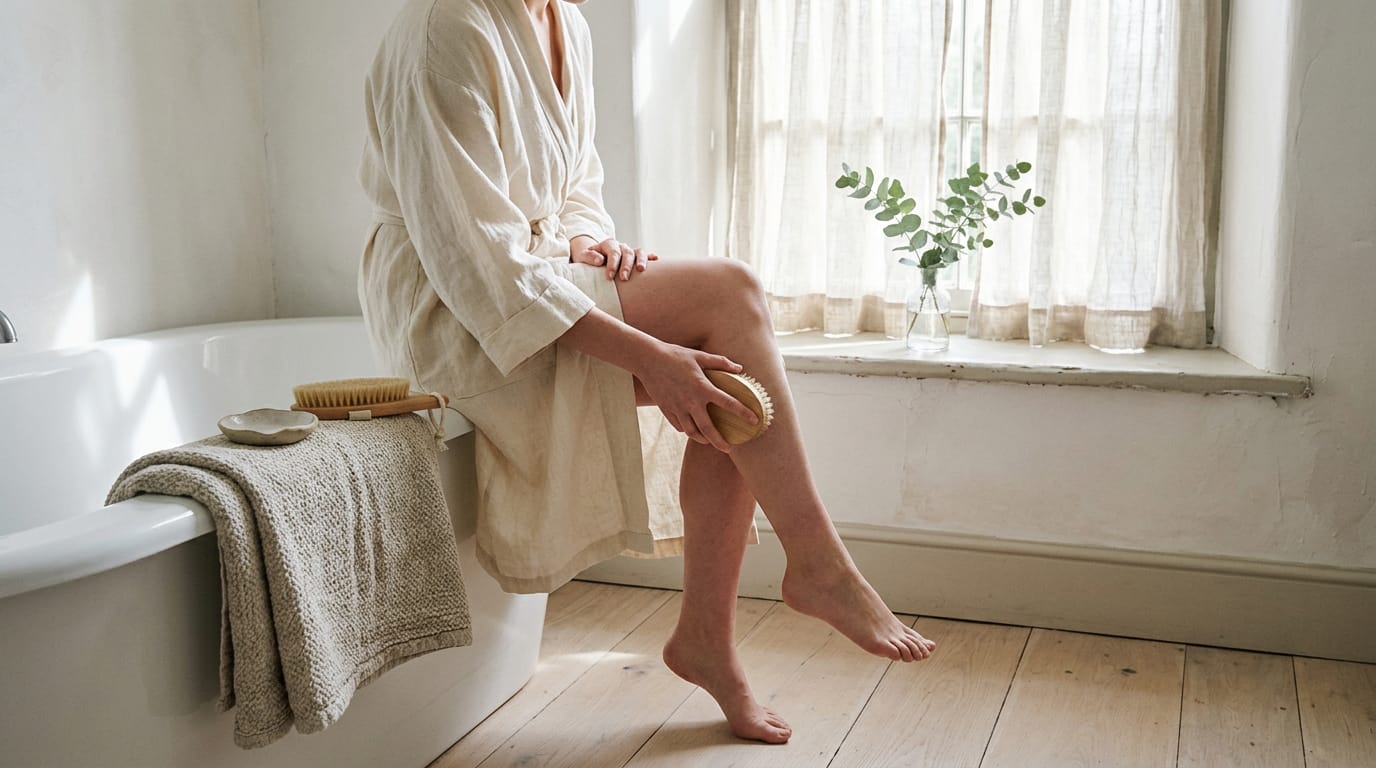
Dry brushing means sweeping a dry, stiff-bristled brush over your skin, usually before you shower. It’s done on dry skin, not wet.
Think of a bridesmaid who wants smooth arms under a sleeveless dress. She spends three minutes with a brush before her shower and still has time for coffee. That’s a short routine that fits right before work.
The strokes are long and firm, so it feels a little like a massage while it works as a body exfoliation step.
Dry brushing removes dead skin cells physically, not chemically. That’s mechanical exfoliation, and the brush does all the work.
Ancient roots across many cultures
Ayurveda, the traditional Indian system of health, includes gharshana, a form of dry massage. A paper in the Journal of Research in Indian Medicine notes that it’s sometimes associated with dry brushing.
Ancient Greece has a link to the practice too. A review of scraping therapy notes that athletes there lathered themselves with olive oil and scraped it clean with a tool called a strigil.
Japan has its own towel massage, called kanpumasatsu. Native American use adds another thread to the story.
It’s a thread that runs through many cultures, not one origin story.
Is Dry Brushing Actually Good for Skin?
Partly. Dry brushing can leave skin feeling smoother and looking a little brighter, but many of its bigger promises have thin research behind them. Here’s how the claims stack up.
Shedding dead skin for a smoother glow
Brushing lifts away dead skin cells through exfoliation, and that’s its most believable benefit. Consider a bride who wants smooth arms under a strapless gown.
Brushing for a few minutes before her shower helps, and a light oil keeps her skin soft all day.
- Smoother, softer skin: Clearing dead cells leaves skin feeling softer.
- Brighter, radiant glow: Less buildup can make skin look more luminous.
- Better moisture absorption: Proponents say lotion sinks in more easily afterward.
- Unclogs pores: The idea is that clearing buildup keeps pores from clogging.
- Helps acne and ingrown hairs: Many people use it for these, but it’s a hopeful claim, not a proven fix.

Whether it really moves blood and lymph
According to Medical News Today, it’s plausible that brushing boosts circulation the way massage can, but there’s no evidence to confirm it.
Lymph is next. A review on lymphatic function describes the Ayurvedic practice behind it as meant to relieve lymphatic congestion, but whether it truly promotes lymph drainage isn’t well established.
Detox is another popular claim: Healthline says proponents believe it may help your body release toxins, a belief rather than a measured result.
A naturopathic medicine guide reports an increase in immune function in one study of Kanpumasatsu, a Japanese dry towel technique. It’s a close relative of dry brushing, not the same practice, so more research is needed.
Feeling energized and calmer afterward
Many people feel invigorated after brushing, and the massage-like sensation can feel relaxing. Claims that it stimulates the nervous system are common, but the research we reviewed doesn’t confirm them.
Think of a new mom who brushes for two minutes before her shower to wake up. She gets a quick lift without another bottle on her counter, though a lasting energy boost is still a claim.
Cellulite and other popular claims
- Cellulite reduction: Dry brushing is widely promoted for cellulite, but nothing we reviewed supports that.
- Collagen production: It’s often said to boost collagen, but there’s no supported evidence here.
- Aiding digestion: Some people say it helps digestion, though there’s no backing for that.
- Lacks scientific support: Most of these popular claims are thin on evidence, so treat them as bonuses, not reasons to start.
How strong the science really is
Let’s be straight about the evidence. News-Medical reports that no clinical data have confirmed dry brushing significantly speeds up lymph clearance or blood flow.
The surface effects are the most believable, while the internal claims are the least proven. It’s a surface story more than an internal one. Smoother, not transformed.
For most people, the risk is low. Later in this article, we’ll cover the exact technique and who should skip it.
How to Dry Brush Your Body
Dry brushing takes about five minutes and fits neatly before your shower. Here’s how we’ll pick the right brush, work through your body in the right order, and keep every stroke gentle.
Choosing a natural, long-handled brush
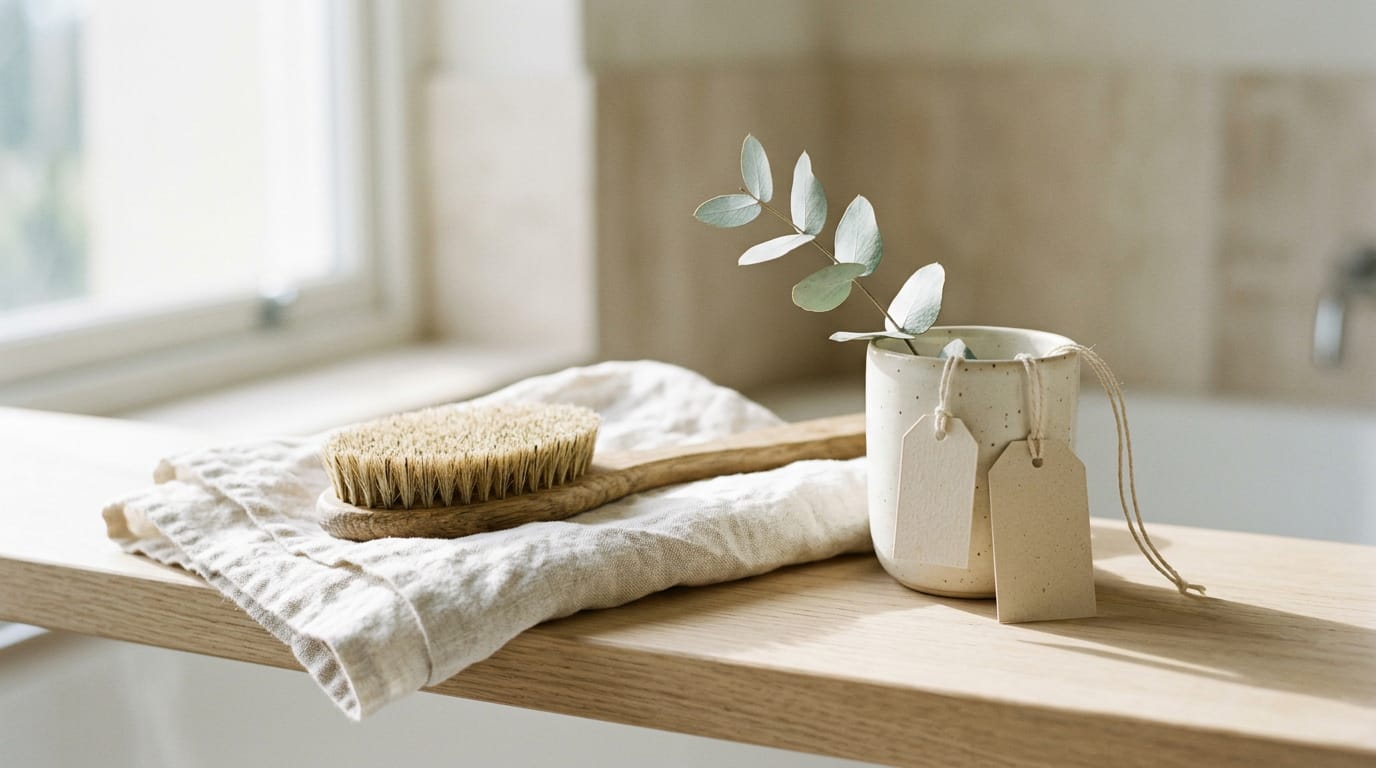
Look for brushes with natural bristles and skip synthetic ones. A long handle lets you reach your back without contorting yourself.
Two common natural options are sisal, a plant fiber, and boar bristles, which come from an animal, so choose whichever feels comfortable on your skin. For sensitive areas like your chest or inner arms, reach for a softer brush.
You don’t need to spend much. A brush under $10 does the job.
Working upward from feet toward the heart
The upward path is the key to lymphatic drainage brushing, so get the direction right. Follow these steps:
- Start at your feet and move upward toward your heart.
- Use long, fluid strokes on your legs and arms.
- Switch to small circular motions across your torso.
- Focus on lymph node areas, such as your underarms and groin, with gentle strokes.
Keep every stroke traveling toward your heart, and you’ve got it.
Keeping pressure light and sessions short
Keep pressure light to moderate, and be even gentler on sensitive areas. You want to brush, not scrub, so let the bristles do most of the work.
Make a few overlapping swipes over each area rather than dozens of rushed ones, and keep the whole session to two to five minutes. Start light. Build up only if your skin handles it comfortably.
When and how often to brush
You can dry brush daily, once a week, or two to five times a week, depending on your skin and schedule. Choose morning over evening when you can, since it slots in before work.
Consider a bridesmaid who brushes each morning the week before her friend’s wedding, so her skin still looks like her skin when the big day arrives.
Brushing goes before your shower, not after it, so it sits at the start of your body routine.
Rinsing, moisturizing and cleaning up after
Shower to rinse off the loosened flakes, then moisturize or apply oil. Pair it with a light body moisturizer so your routine stays quick. Dry brushing differs from other exfoliants like scrubs, which you usually use on wet skin.
Here, you brush dry skin, and the flakes rinse away in the shower.
Keep your brush in good shape with a few simple habits:
- Wash it weekly. Wash it once a week so it stays clean.
- Air-dry it in the sun. Let it dry fully before you put it away.
- Don’t share it. Keep it to yourself.

Who Should Skip Dry Brushing and Why
Dry brushing isn’t right for every body. Here’s who should hold off, where to keep the brush away, and what to avoid.
Eczema, psoriasis and sensitive skin
If you have eczema (dry, itchy, inflamed skin) or psoriasis (raised, scaly patches), skip the brush. Use a dry washcloth on areas that feel fine, and check with your doctor or dermatologist before adding any new step.
Sensitive skin deserves the same caution, as does any patch touched by poison ivy or poison oak.
Consider a bride with a flare on her inner elbow. She skips that spot, brushes her legs as usual, and walks into her fitting without a red arm to explain.
Where to avoid brushing on your body
Keep the brush away from:
- Broken skin, including cuts and wounds
- Infections and rashes
- Moles, warts and other growths
- Sunburned skin, and any spot a doctor is checking for skin cancer
Brush around a problem, not over it. Your face is usually skipped altogether, so keep the brush on your body.
Mistakes that irritate your skin
Most irritation comes from how you brush, not the tool:
- Brushing too hard. Use gentle pressure, not force.
- Micro-tears and irritation. Pressing hard can cause tiny tears that sting and turn red.
- Overbrushing. Going back over the same spot again and again invites irritation.
- Skipping moisturizer. Finish with a moisturizer so skin doesn’t feel tight.
- Layering strong acids. Don’t stack them on freshly brushed skin, since it may sting.
Stop if you notice redness or swelling, and let the area settle before you brush it again. Calm skin comes first.
Dry brushing is a short, simple habit: brush dry skin with a body brush, shower, then follow up with a moisturizer or oil. Knowing what it can do, how to do it gently, and when to sit it out is what makes it worth your time.
Start light, pay attention to how your skin responds, and keep it only if it fits your schedule. The best body routine is the one you’ll actually keep up, and that’s a win you’ll notice every single day.
References
- Journal of Research in Indian Medicine An Official Publication of Bureau for Health & Education Status Upliftment (Constitutionally Entitled As Health-Education, Bureau) — onlinejournals-heb.pen-nic.in
- Exploring scraping therapy: Contemporary views on an ancient healing — pmc.ncbi.nlm.nih.gov (2021)
- Lymphatic Function in Autoimmune Diseases — pmc.ncbi.nlm.nih.gov (2019)
- Dry Brushing Benefits: Get Glowing Skin Naturally — aanmc.org (2025)
- Dry Brushing: What Are the Health Benefits and Potential Risks? — news-medical.net (2025)
- Dry brushing: Benefits, myths, and how to dry brush — medicalnewstoday.com
- Dry Brushing: Potential Benefits, Risks, and How to Try It — healthline.com
- Cellulite: What It Is, Causes, Location & Treatment — my.clevelandclinic.org
Questions
How many times a week should I dry brush my skin?
You can dry brush daily, once a week, or two to five times a week, depending on your skin and schedule. Start gently and reduce the frequency or stop if you develop irritation.
How to dry brush your body for lymphatic drainage?
Brush dry skin with light pressure, using long strokes from your feet and hands upward toward your heart. Use small circles on your torso and gentle strokes near areas such as your underarms and groin. Dry brushing may be intended to support lymph flow, but its effect on lymph drainage has not been well established.
Is dry brushing actually good for your skin?
Dry brushing can exfoliate dead skin cells, leaving skin feeling smoother and looking a little brighter. Claims that it treats acne, reduces cellulite, boosts collagen, or meaningfully improves lymph drainage are not well supported, and brushing too hard can irritate or damage skin.
Do you dry brush before or after a shower?
Dry brush before your shower, on bare, dry skin. Shower afterward to rinse away loosened flakes, then apply moisturizer or oil.
Sources
- Exploring scraping therapy: Contemporary views on an ancient healing – A review, pmc.ncbi.nlm.nih.gov,
- Journal of Research in Indian Medicine An Official Publication of Bureau for Health & Education Status Upliftment (Constitutionally Entitled As, onlinejournals-heb.pen-nic.in
- Dry brushing: Benefits, myths, and how to dry brush, medicalnewstoday.com
- Lymphatic Function in Autoimmune Diseases - PMC, pmc.ncbi.nlm.nih.gov,
- Dry Brushing: Potential Benefits, Risks, and How to Try It, healthline.com
- Dry Brushing Benefits: Get Glowing Skin Naturally | AANMC, aanmc.org,
- Cellulite: What It Is, Causes, Location & Treatment, my.clevelandclinic.org
- Dry Brushing: What Are the Health Benefits and Potential Risks?, news-medical.net,
The Journal